…but this was a little different because we were able to cover taxonomy and learn some organizing principles about the various groups. It was kind of nice to pull way out and do that overview to get the big picture.
Due to remarkably good planning (hee hee) we were talking about classification soon after Halloween, which naturally led us to do a classification activity with the children's Halloween candy. They saw that there are many useful ways of dividing up, sorting, and labeling the same items!
We divided this unit up into Invertebrates, Reptiles, Amphibians, Fish, Birds, and Mammals. We also covered Habitats, Predators and Prey/Food Webs, Adaptations, Life Cycles, and Animal Families.
We loved this movie called Octopus: Making Contact (and octopuses are our new favorite animal!)
I also read this book The Soul of an Octopus (super interesting), and Sam and I watched and really liked this movie (My Octopus Teacher) even though it looked at first like it would be very boring :)
LOTS of fun books available for this unit…you really could fill up a whole year! And we did a lot of crafts too, which I will link to in a separate post.
I think this was our longest unit this year. Have I mentioned that this was a strange year? It was really different for us because for the first time we had lots of things going on outside of our "Family School." The older boys had classes once a week at a co-op, plus some extra sports (and Abe turned 1 and got a job!), the girls were doing swimming and gymnastics with money from an online charter school, and all of the children had extra technology and science classes that weren't completely put together by me! It was fun to have some variety, but a little sad to give up some of the time together that we've loved. I guess that's what happens as the children grow up!
Anyway, we kept our family school units going twice a week, so everything took a little longer to get through, but we still had a good time. Here are some links we found useful:
Here we have 6 molecules of CO2 and 6 molecules of H2O…
Which are re-organized into a huge glucose molecule (C6-H12-O6) and 6 molecules of O2!
We loved modeling photosynthesis and cellular respiration! It makes it so much clearer when you can see the components actually being reused in different molecules. This is the basic idea, but we used marshmallows instead.
One day we tasted foods that come from all parts of a plant.
You can see a liiiiiittle blue in the petals, though.
We started a bunch of seeds indoors because it was too cold outside. I've never done that before, but it was fun. Malachi used them for his herb garden project, for one of his classes at the co-op we're part of.
Here are instructions for making a terrarium. We loved making these! I used assorted containers I found at the thrift store for a dollar or two. And they instantly made the house look so green and vibrant! I am not used to having many plants around (inside, anyway).
The best part of these terrariums (terraria?) was putting little tiny animals in them!
We have this little microgreens planter and we love it! Microgreens are just baby vegetables. They are a little more mature than sprouts (which are just barely-sprouted seeds), and they have tiny new leaves rather than just the first cotyledons, but you can use any kind of seeds to grow them. I think these were broccoli and radish greens. Or maybe mustard? Or maybe basil? I can't quite remember. We have tried lots of kinds! They all taste a little different. This batch grew really fast—they had sprouted by the second day!
You harvest the microgreens just by clipping them with scissors. We ate this batch on grilled cheese sandwiches and they were SO GOOD. We also like them in scrambled eggs. Or sprinkled on pasta. Yum!
This was a pretty short unit, and we have learned about some of these concepts before, in our Nervous System and Light and Optics Units. (And even way back in our Illusion Unit!) But it was a fun review, and we loved all the cool Optical Illusions books we got from the library!
The best part of our unit was visiting an optometrist's office. He is a homeschool dad, and he was wonderful at explaining to the children what he does and how all his cool equipment works. We loved it!
Goldie loves elephants, so we did an Elephant Unit for her first "official" unit of Kindergarten! She had just seen real elephants for the first time on our trip to the Wild Animal Park, and then we ended this unit with a field trip to the zoo, so it was an exciting couple of months for her! She was so happy.
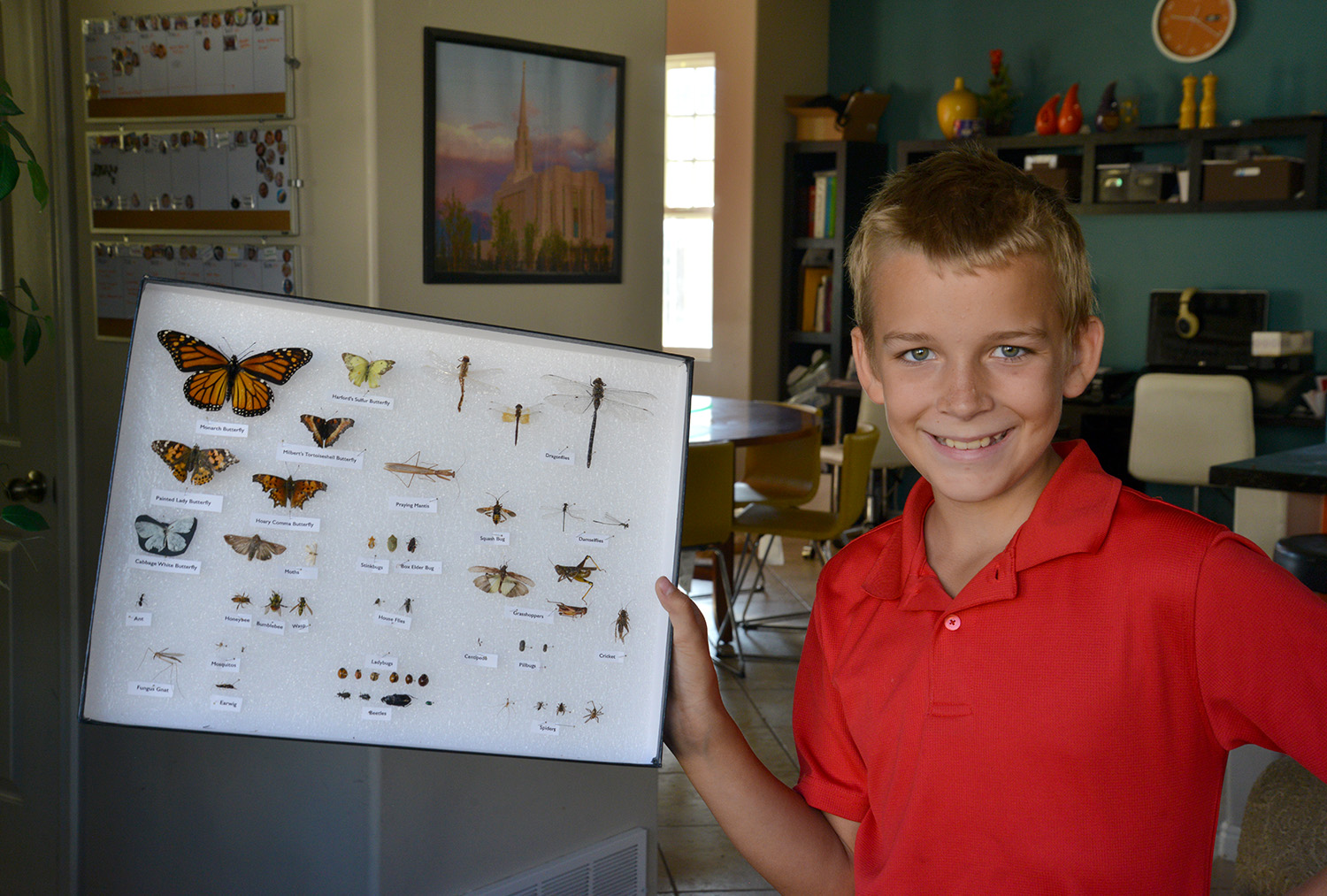
I mentioned before how much I liked making an insect collection when I was in sixth grade, and I think I enjoyed it even more this time. The children did most of the actual hunting, but it was so exciting every time we found a new insect! There were a few other insects we would have liked to find: a katydid, a stick insect, a centipede (not an insect, but we still wanted one), and a bigger moth. But we really got most of the things we hoped to get, and we love the way our collection looks now!
We labeled our specimens the best we could using our Insect and Butterfly Guides, but we may have gotten some wrong—sometimes it's so hard to tell! But it was fun trying to figure out what we'd found, anyway. We decided not to include orders and classes and scientific names, for the sake of simplicity (we liked how the collection looked better without large labels).
We ordered several things from Home Science Tools which made collecting even simpler. Here are the supplies we got:
Basic insect collecting kit. The spreading board was really useful, as were the forceps, and the pins of course. And the killing jar worked great. I hate the killing part (I always feel so sad for the poor little insects!) so it is nice to know that it's quick and painless. You can order more of the ethyl acetate if you run out (we didn't get even close, though).
Nets. We got a kid one and a standard one and they both worked well. We liked the longer handle best.
Display box. First we just had this basic box, but it started to fill up and when our specimens were looking so great, we decided we might actually want to display them. So this nicer box is perfect!
We took the glass lid off of the box for the other pictures, to get rid of the reflection on it, but I think the collection looks even nicer under the glass. We like it so much that we're going to hang it up on the wall!
We really loved this craft, shown here (with more instructions in this video. I can't stop thinking about the cute way she calls them "paddle-pop"[? or pad-a-pop?] sticks. Adorable.). There are actually several really cute caterpillar and butterfly crafts on this page, but this one was my favorite because of the way it transforms from caterpillar to butterfly. And we used Sharpie, naturally, instead of painting, because whenever it is possible to make something easier and less messy, I try to do so. :)
We ran out of popsicle sticks after four kids, so for the younger two (who naturally couldn't BEAR to be left out of the craft-making), I improvised with an accordion-folded piece of paper. It worked fine and they were so happy to have their own little caterpillar/butterflies to play with! (Besides the real ones, of course!)
Goldie took it all very seriously.
These girls LOVED telling the story of their caterpillars' life cycles as they played with these.
Malachi's nice fat rainbow caterpillar.
Ky added his own twist by drawing a chysalis on the back of the popsicle sticks, so that you could fold the sides in and let the caterpillar metamorphose inside before changing into a butterfly. Everyone else liked that and copied it on their crafts too. (And Malachi was very pleased with himself for having the caterpillar leave that "Sorry, be in the next picture" sign on the "door" of his chysalis. Ha!)
And here is Malachi's butterfly. So cute!
Seb spent such a long time making his Monarch butterfly beautiful and accurate that he didn't want to spoil the effect by gluing fwuffballs down the thorax (much as he likes fwuffballs).
Inspired by these lovely insect collages, we went on a little nature walk and gathered materials, then made these Butterfly Life Cycle collages with what we found. As you can see they weren't ideal for laying flat and putting in binders, but they were still fun to make. :)
For more on the life cycles of insects, and photographs of the different stages, see this post. (And for another craft, see here.)
Junie really loved this project. She made several different pictures. Here are two of them.
Abe's "Orange Morpho."
Malachi's cute little egg, caterpillar, chrysalis, and butterfly.
As soon as I started planning this Insect Unit, I thought, "We have got to order one of those caterpillar metamorphosis kits again!" We had done it awhile ago and LOVED it. I asked the children if they remembered and was astounded to realize that it was NINE YEARS AGO! And only Abe really had memories of it!
It is a really fun thing to do. You order the caterpillars and they come in a little cup, and grow at an incredible rate. The cup has all the food they need, so all you do is watch them as they get huge, and then turn into chrysalises, and then emerge as beautiful Painted Lady butterflies!
Speaking of chrysalises (or chrysalids, as we learned is an alternate plural form…doesn't it seem like it ought to be "chysali"?)—maybe you have read Eric Carle's explanation of why HIS hungry caterpillar makes a cocoon instead of turning into a chrysalis? It's charming. And we were very interested to find out the difference between a cocoon and a chrysalis. A cocoon is like a little web that the caterpillar spins around itself, which then hardens to protect the changing caterpillar inside. And a chrysalis IS actually the caterpillar…changed into a different state (the pupa) and with a hardened outer skin. Most butterflies form a chrysalis and most moths spin cocoons. You can read more about that here, among other places.
Cute little caterpillars on successive days.
They attach themselves to the top of the cup with a little silk pad. You can see how at first they still look like caterpillars. Then they molt one last time, and suddenly…they are chrysalises!
Once they have hardened for a couple days, you can put them upright in this little holder. And what is strange…they seem like just husks, but they are still kind of…alive. And if they get bumped or startled they will start to wiggle and shake themselves around! It is the weirdest thing to see. We laughed and laughed! Here is a little video:
They were startled because one butterfly had emerged and bumped the other chysalises on his way out! :)
Three butterflies have emerged. You can see their empty chrysalises. Two to go!
When the butterflies were all out, we kept them in their little habitat for a few days, and then finally, reluctantly, let them go. We had grown to love them in that time. :) The children loved to put their hands into the habitat and let the butterflies land there and walk around with their tickly little feet. Sometimes a butterfly would put out its proboscis and taste someone's finger, to our great delight!
Before we let the butterflies go, though, we had caught a couple Monarch butterflies. We thought they were so beautiful we wanted to keep them and watch them for awhile, so we put them in the habitat with the Painted Ladies. We don't know how all the butterflies felt about that, but they didn't seem to bother each other too much, anyway. It was so fun to watch them flying around and sipping nectar! We finally forced ourselves to put one of the Monarchs in the killing jar for our collection (we were so sad! But we assured it that it would live on in our hearts forever!), and then we let the other one free with the Painted Ladies. But not before Junie did lots of collegial flitting about with her own Monarch wings!
Our butterflies flapped around us saying "thank you" and "goodbye" for awhile before flying away. We were sorry to see them go, but happy that they got to go out into the beautiful world at last!




.JPG)