Showing posts with label math. Show all posts

Monday, March 14, 2016

Currency and Counterfeiting

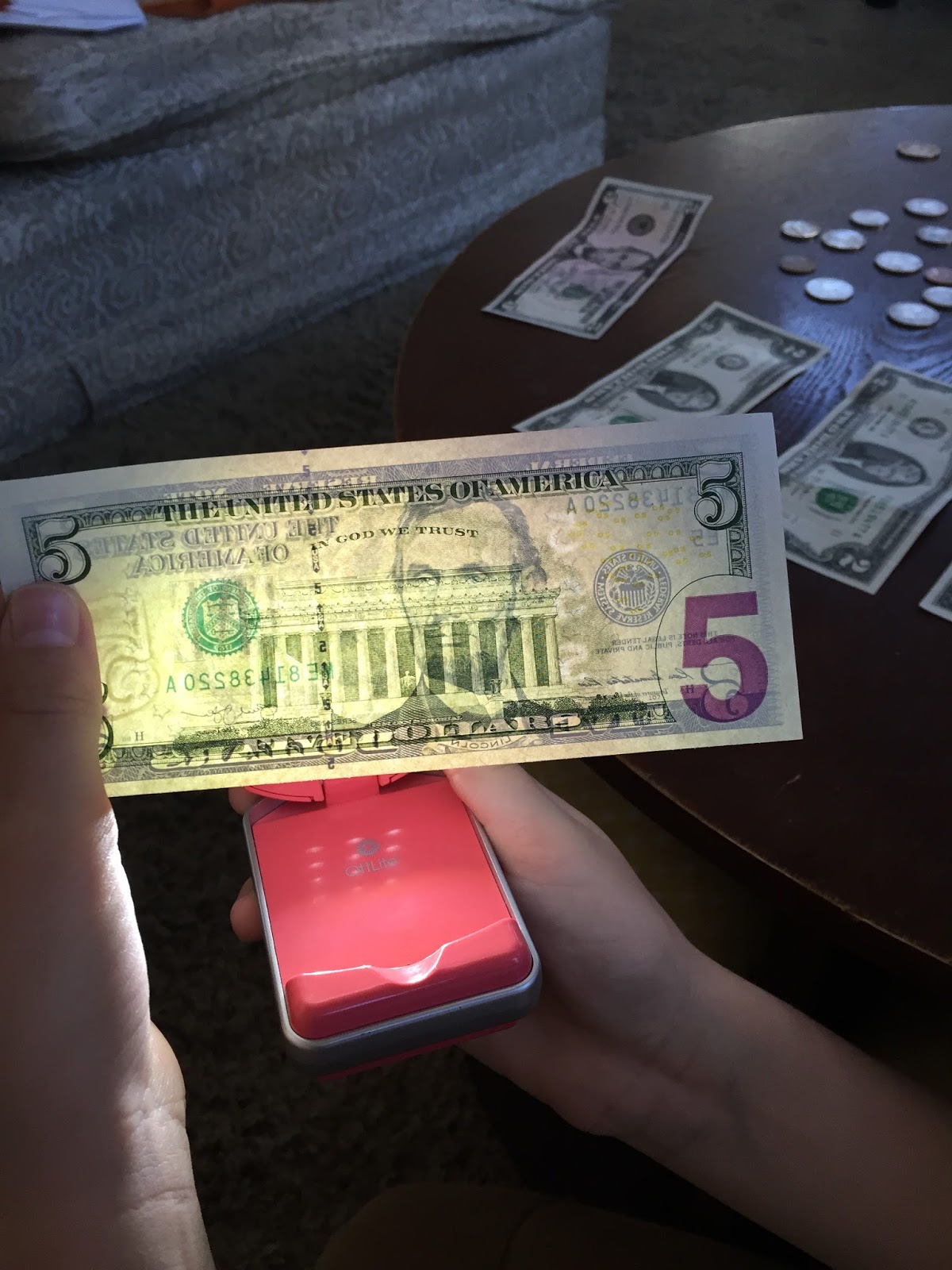
Before we learned about currency, I went to the bank and got out one of everything—gold dollars, half dollars, and all the other coins and bills. I don't know if I've ever even seen one of the new $100 bills before! Certainly I've never examined one. They look very different and cool. The children were FASCINATED by all the security features on the newer banknotes.
Things like the watermarks and security strips, and the microprinting. 

Speaking of security features, we learned that Photoshop won't allow you to open a picture of any U.S. Currency in it. A message pops up saying it's forbidden. And I wasn't even planning to counterfeit anything! Hmmph. I was offended. You have to deal with the pictures above being unedited. (I am curious about how Photoshop recognizes banknotes when you TRY to open pictures of them. How does it know?!?)

I checked out a book about a famous counterfeiter from the library, called The Art of Making Money. I intended to tell the children about it after I finished it. It was really an interesting book and I learned lots of things about money as I read it, but it was also a very depressing book, and I felt so sad after reading it—just sad for the way crime (even so-called "victimless crime" like this—he sold much of his counterfeit money to drug dealers and others for 30 cents on the dollar, and then they used it to pad out their payoffs to other drug dealers, etc.) brings unhappiness to the people who engage in it. And sad for the way that cycles of crime and wickedness repeat themselves. So I didn't really end up telling the children about counterfeiting so much as more philosophical matters, but I guess that's okay. :) 

Other activities:
Coin rubbings
Looking at foreign currencies
This was fun: we tested a whole bunch of different materials to see which we thought would make the best money. We needed something not too bulky, that could be folded tightly but that also wouldn't weaken too much along the fold line; something reasonably waterproof; something that would take ink well enough to allow crisp text printing; something that wouldn't tear easily; something pocket-sized. I let the children test all the materials in water, write on them, try to rip them, etc. and then decide which materials were best for making currency out of. It was easy to see why metal for coins is so popular, and why the thin cotton fabric/paper used by the U.S. works well. Have you seen the new Canadian bills, though? We saw some when we were in Montreal last summer and they are made of actual plastic! So interesting.
Abe got out all his money (he does have a bank account, but he'd been saving up at home for quite a while since his last trip to the bank!) and lined it up so we could all ooh and aah over it. :)

More resources on currency:


I had heard of Bitcoin before and never really understood what it was or how it worked. But I wanted to. So I read a couple whole books about it, and I'm still not sure I understand it completely! But we also found some videos and graphics that helped explain the concept. It's pretty complicated, but with me explaining what I could, and watching videos, the children got the basic idea. They (especially the older boys) were really fascinated with the whole idea of creating a currency from scratch!

We found quite a few videos about how currency is actually…manufactured? Printed, I guess. This one is good. So is this one. This one was longer, but interesting. This one shows Euro coins being made.

We also watched an older movie I'd never heard of, Who's Minding the Mint. The children thought it was HI-LARIOUS. And I laughed out loud myself a couple times. It's one of those weird sixties movies like It's a Mad, Mad, Mad, Mad World. And it shows money being printed! :)

Wednesday, March 9, 2016

Bartering Activity

As multiple books on money pointed out, bartering is what all children do automatically with their Halloween candy! Everyone has probably had some experience with trade and barter. But this activity made it a little more regimented. Each child got a small bag of a different kind of candy. I had them make charts to show how much value each kind of candy had to them personally, and then I just let them have at it! It was interesting to see which kinds of candy became more valuable as the activity went on (because of scarcity…some people were more reluctant to trade than others) and which things the children thought they valued, but found themselves settling for less with as the trading frenzy took over. :) Some of the kids were more methodical about it, trying to amass a variety of candy across genres. Others seemed to like the act of trading more than the commodities they actually traded for.

And the children, of course, were just super excited to have all these good things to eat!

Monday, March 7, 2016

Economics and Money Homeschool Unit

(Click any section to enlarge)
I've been wanting to do a unit on Economics for a long time, but every time I started trying to prepare for it, I had such a hard time finding the kind of information I wanted! There are plenty of ideas out there for teaching about money management, and many of those are good. And there are, of course, advanced Economics courses for high school and college students that talk about Keynesian Economics vs. Supply-side Economics and so forth. But after searching through a million lesson plans and websites and books, I realized that what I REALLY wanted was a curriculum featuring the plain-English fundamentals of Thomas Sowell's Basic Economics…but for kids. Which meant I would just have to make it up myself!

If you know me very well, you've probably heard me praise Basic Economics. As I said in this post, at the risk of sounding somewhat fanatical, it was a life-changing book for me. The entire time I was reading it (and its sequel, Applied Economics) I kept thinking, "EVERYONE needs to read this book. Everyone!" And I do recommend it to everyone I can (including the hairdresser…), but I have little hope of actually getting anyone else to read it. It does sound so very boring!

However—my children are the perfect captive audience, and before I ever even knew I was going to homeschool them, I had already vowed that they, at least, would be exposed to the fundamental principles set forth in these books. I see these ideas as some of the most important ones for living a happy and grateful life! Things like understanding scarcity and trade-offs. Realizing that cost and price are not the same thing. Accepting and balancing risks. All the children's books about opening lemonade stands and using a bank account and credit cards and "save, spend, give" are fine—but they seem incomplete without the underlying principles and context. 

I don't mean to denigrate any other methods out there—I know Dave Ramsey has a course people speak highly of, and I'm sure there are many others—but especially in the current political climate, I really wanted to weave in some of the great truths I've learned from Thomas Sowell and Milton Friedman. And to discuss some of the ways economic truths support and point to religious truths as well. If only all high school and college students could learn this stuff, maybe this country wouldn't be where it is now…*sigh*…but I digress.

Although I don't have a ton of posts and pictures about activities we did, (much of our time was spent having conversations based on notes I have from the books, and unfortunately I only had brief outlines; nothing very useful to anyone else) this was quite a lengthy unit, and a really fun one. I think it was one of our very favorites, which is saying something!

Here is my Pinterest page for the Economics and Money Unit.

To conclude: Thomas Sowell says that most of the world's economic and political problems could be solved if people would simply ask these three questions:

Compared to what?
At what cost?
And then what will happen?

Hopefully this unit helped us all become more practiced at asking and answering these things!

Oh, and one more pressing question…is it EEE-conomics, or Eh-conomics?? The answer is…both. I guess. Or either. I think I switch off between them. :)

Wednesday, March 25, 2015

Simple Machines: Wheels and Axles (and gears)

I guess I didn't take any pictures of our wheel and axle activities, but I'll include a few links.

First of all, I thought it was interesting to think of a wheel as simply a type of lever—one that rotates around 360 degrees. This video I mentioned on the Screw post, plus this other video about wheels, were really entertaining and informative.

This page is full of good ideas for wheel-related activities. They also made a waterwheel, which is something we did during our water unit a few years ago. It's really fun.

We chose to study gears along with wheels, and here are some gear activity ideas.

Another gear video.

We also talked about ratios and how they relate to gears.

And just in case you've ever wondered what the difference is between a gear and a sprocket, you can find out here!

To show how wheels can help you measure things, we made surveyor's wheels or measuring wheels, sort of like these described here.

We looked at the gears on our bikes and noticed how, just like with levers, increasing the size of the spokes or pedals can change your mechanical advantage.

We watched a couple videos about how wheels are even used in the natural world! For example, these rolling salamanders and caterpillars use the principle of the wheel to escape from danger.

And these leaf-hoppers actually have microscopic gears to ensure that both their legs spring at the exact same time when they jump. Amazing!!

Monday, November 3, 2014

Gummi Bear Graphing

There's a pizza buffet we go to sometimes which, for awhile (before they took the costs of my children into account, presumably) had Gummi Bears as one of the "salad bar" items. (??) The children treated them like manna from heaven. They'd get a bunch of gummi bears and then line them up in rainbow order and compare them with each others' and eat them carefully one color at a time.

So, I decided to buy a bag of Gummi Bears and put all that OCD behavior to good use making graphs. We created various types of graphs and charts of Bear Color, and made estimates, and drew conclusions, about the number of bears per color per bag. Very interesting (and the children thought the bears were SUCH a special treat!).

Tuesday, October 29, 2013

Pyramids

We spent our first day of this unit talking about pyramids and triangles. Of course, we covered the Great Pyramids in Egypt, but we also talked about modifications of that idea----the ziggurats, pyramids of the Inca and Maya, etc. I had to go somewhere in the middle of the day, so I told the boys to figure out how to make three-dimensional pyramids from paper while I was gone. They learned a lot from figuring that out all on their own---for example, that a polygonal base determines the number of triangular sides of the pyramid. They also learned how different sizes of triangles produced different pyramid heights (and/or gaps between sides, if they were irregular).

When I got back, we printed out a bunch of templates and made a whole city of pyramids. We found the templates at this great site---it has pdf's of all types of pyramids for you to fold. You can choose how many sides you want your pyramid to have. There are also all sorts of other polyhedra to print and make. Really fun.
We absolutely devoured David Macaulay books during this unit---he's one of our favorites. Pyramid, of course, was for this day.

Somebody made a step pyramid with blocks. There's a tomb under it (see the circular entrance near the bottom).

Thursday, August 15, 2013

Beehives, Polygons, and Comb Construction Project

Beehives and comb cells are some of the most amazing things! To discover how hexagons are one of the strongest shapes for building with, we made various polygons out of paper---but first we investigated something intriguing I read in this book. The author says: 
"Recently, it has been suggested that the hexagonal cells are an 'emergent property,' that is, at the right temperature . . . the hexagons form on their own. First the bees make cylindrical tubes around themselves and then the hexagonal angles form. Chemically, the beeswax transforms from an amorphous (or unorganized) state into a crystalline state."
To test this, we rolled some clay cylinders out, about pencil size.
We put them into a group and squeezed them slowly together.

You can see that they have (kind of) formed hexagons! If our cylinders were more precise, and our squeezing more uniform, I think it would have been even more obvious.

We also had a good close look at this abandoned wasp's nest we found outside.

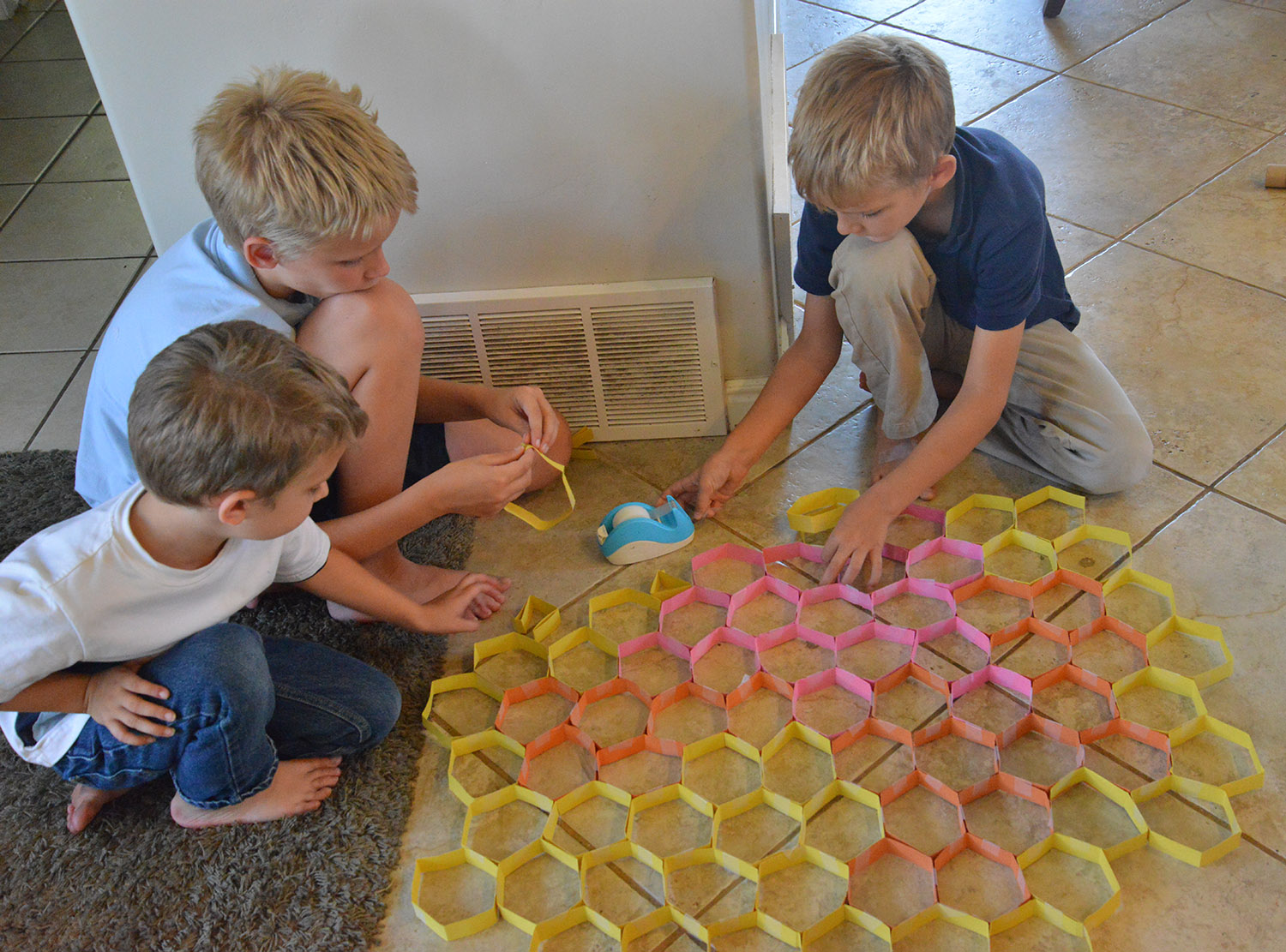
Next, we made polygons out of thin strips of paper. We measured the paper strips and figured out how many inches we'd need each side to be for squares, triangles, pentagons, hexagons, and octagons. We each made a couple examples of each type of polygon. Then we joined polygons of the same type together to see how they fit. We put a little foam ball inside each cell to see which cells were the roomiest for holding larvae and pupae.

We discovered that hexagons provide the least wasted space and the most interior space, for the least amount of material needed (perimeter) to make them.

After that, we made comb cells with different colors of paper to represent their different functions. Honey cells were yellow, pollen cells were orange, and brood cells were pink. We arranged these cells in their relative places in the hive (see page 32-33 of this packet for an example).
It was fun and oddly satisfying to make hexagon after hexagon and then tape them together. We would have kept going for longer if we hadn't gotten hungry for lunch.

We hung our finished comb up in a doorway. It got a little stretched out, but we didn't mind.

This is a queen cell hanging off the bottom. With a queen emerging from it.


 We had so much fun with our big beehive that we made smaller ones too. These were made with half-size and half-width strips of paper. We put them on top of white paper so we could draw what each kind of cell was holding inside. Here is Malachi's beehive with honey cells, pollen cells, and brood cells. I love it!

Thursday, June 27, 2013

Civil War Spies and Ciphers

Who doesn't love a good code? We talked about communications in the army, and various codes and ciphers used by the Union and the Confederacy. We also read some great books about Civil War spies---I think our favorite was Sarah Emma Edmonds was a Great Pretender. At one point she was a girl, pretending to be a man in the Union army, pretending to be a female slave in the Confederacy! Amazing.

We had a great time writing secret messages to each other using cipher squares. You can find instructions on this here. The concept is simple, but the codes are surprisingly effective!
Related Posts Plugin for WordPress, Blogger...