Tuesday, September 20, 2016

Raising butterflies from a kit

As soon as I started planning this Insect Unit, I thought, "We have got to order one of those caterpillar metamorphosis kits again!" We had done it awhile ago and LOVED it. I asked the children if they remembered and was astounded to realize that it was NINE YEARS AGO! And only Abe really had memories of it!

It is a really fun thing to do. You order the caterpillars and they come in a little cup, and grow at an incredible rate. The cup has all the food they need, so all you do is watch them as they get huge, and then turn into chrysalises, and then emerge as beautiful Painted Lady butterflies!

Speaking of chrysalises (or chrysalids, as we learned is an alternate plural form…doesn't it seem like it ought to be "chysali"?)—maybe you have read Eric Carle's explanation of why HIS hungry caterpillar makes a cocoon instead of turning into a chrysalis? It's charming. And we were very interested to find out the difference between a cocoon and a chrysalis. A cocoon is like a little web that the caterpillar spins around itself, which then hardens to protect the changing caterpillar inside. And a chrysalis IS actually the caterpillar…changed into a different state (the pupa) and with a hardened outer skin. Most butterflies form a chrysalis and most moths spin cocoons. You can read more about that here, among other places.
Cute little caterpillars on successive days.
They attach themselves to the top of the cup with a little silk pad. You can see how at first they still look like caterpillars. Then they molt one last time, and suddenly…they are chrysalises!
Once they have hardened for a couple days, you can put them upright in this little holder. And what is strange…they seem like just husks, but they are still kind of…alive. And if they get bumped or startled they will start to wiggle and shake themselves around! It is the weirdest thing to see. We laughed and laughed! Here is a little video:
They were startled because one butterfly had emerged and bumped the other chysalises on his way out! :)
Three butterflies have emerged. You can see their empty chrysalises. Two to go!

When the butterflies were all out, we kept them in their little habitat for a few days, and then finally, reluctantly, let them go. We had grown to love them in that time. :) The children loved to put their hands into the habitat and let the butterflies land there and walk around with their tickly little feet. Sometimes a butterfly would put out its proboscis and taste someone's finger, to our great delight!
Before we let the butterflies go, though, we had caught a couple Monarch butterflies. We thought they were so beautiful we wanted to keep them and watch them for awhile, so we put them in the habitat with the Painted Ladies. We don't know how all the butterflies felt about that, but they didn't seem to bother each other too much, anyway. It was so fun to watch them flying around and sipping nectar! We finally forced ourselves to put one of the Monarchs in the killing jar for our collection (we were so sad! But we assured it that it would live on in our hearts forever!), and then we let the other one free with the Painted Ladies. But not before Junie did lots of collegial flitting about with her own Monarch wings!
Our butterflies flapped around us saying "thank you" and "goodbye" for awhile before flying away. We were sorry to see them go, but happy that they got to go out into the beautiful world at last!

Monday, September 19, 2016

Insect Encounters

During this unit we started noticing bugs everywhere, as you always do when you're studying something. It was fun to watch the children catching little bugs and making friends with them---even more than usual. :) We seemed to find an unusual amount of grasshoppers. Sebby was so pleased when this one hopped onto his shoulder!
I bought a few crickets at the pet store for us to observe. They didn't chirp much but it was still fun to watch them hopping around. When we were done, we let them go (I hope they were grateful not to be fed to a tarantula or something!).
Here is Junie's bee! She brought it inside to show me and I couldn't believe it wasn't stinging her! She said, "He wouldn't sting me; he LOVES me!" I guess he did. Although the little girls did get stung by bees at other times during this unit. (And it didn't dampen their enthusiasm one bit!) Luckily none of us are allergic, so it's no big deal. (We mostly feel bad for the poor BEES!) You dab some bleach on the sting and it takes the pain right out. Do you know that trick? I still remember my mom doing it to me when I was young and the pain going away like magic. It still works. I wonder why? I've never heard about it it anywhere else.

Praying mantis! We love these.
Children all congregated around some interesting insect or other.

Friday, September 16, 2016

Firefly Glowstick Games

When we studied fireflies, we learned that each species uses a distinctive flash pattern to identify themselves and attract mates. So, to demonstrate this, we went over to our church gym (because it was a nice big space to run in, and because we couldn't find a place where it would be pitch dark in our house) and I brought glowsticks in three color pairs: two pinks, two blues, two greens. I gave one glowstick to each child. Then we turned out the lights, and the children that had matching colors had to find each other by flashing and waving their lights.

It was surprisingly fun. They had fun locating their "mates," but then they came up with all kinds of other firefly games too--races and relays and so forth. The glowsticks gave off just enough light that you could (mostly) avoid running into walls, but it was dark enough that everyone was laughing and squealing and having near-collisions. Good times.

Glowsticks are a pretty good representation of a firefly's bioluminescence, since they are both "cold" light created by chemical reactions. We so wish we had fireflies around here, because we love them! But at least some of us have finally have seen them in real life, when we went to Montreal last summer. And maybe someday we'll really get lucky and see some here in Utah!
Firefly mates finding each other
Fireflies starting a race

Wednesday, September 14, 2016

Insect Field Trip to the Monte Bean Museum

When I was little, we used to go to the Monte Bean Museum on BYU Campus about once a month for Family Night. They've remodeled since then, but there are parts that are still the same from way back then...and this is one of them. The insect area! So, of course we had to make time for a field trip to the Museum during this unit. 
This part is new, and cool. Macro photography of various insects. You can zoom waaaay in close and see all the amazing little details. We really liked it.
Goldie likes the elephant
Seb and Goldie
Two little cutie-pies

Monday, September 12, 2016

Ladybug Models

Ladybugs are so cute that it's easy to find crafts featuring them! People have ladybug birthday parties, etc., and there are all kinds of cute ideas. I was looking for one that had some degree of accuracy and not ONLY cuteness! This ladybug was a combination of a couple of other crafts I saw (chiefly this darling birthday party invitation) and it's a good illustration of the most prominent feature of the order coleoptera, which ladybugs and other beetles belong to: their hard shell-like outer wings which protect the thin inner wings. Coleoptera means "sheath wing," and in ladybugs, the red and black outer wings (or yellow and black, or whatever) are the "sheath," and the clear inner wings are the ones they use for actual flying.

These paper ladybugs have a colored outer wing, with clear wings (we used waxed paper) underneath and then their colored thoraxes and abdomens underneath that. Some of the children made legs, antennae, and probosces out of pipe cleaner, too.

As I mentioned elsewhere, we had fun making a larger number of "crafts" than usual during this unit. I leaned more toward the younger grades when choosing activities, because those types of resources were easy to find, and for Junie and Daisy's sake (and Marigold always wanted to join in too). But it surprised me how much the older boys enjoyed working on this type of thing as well. They would often spend quite a lot of time coloring or gluing and making everything just right. I think they found it kind of satisfying, and they seemed quite (quietly) proud of their finished projects.
I let the children use any colors they wanted for their ladybugs, since in real life they do come in a rainbow of colors!
Daisy wore her beetle shirt many, many of the days during this unit. She liked to accessorize with her dragonfly and butterfly hair clips as well. Here she is posing with her "I'm big" expression (she told me).
I liked Malachi's tiny ladybug, too.

Friday, September 9, 2016

Bee Dance Treasure Hunt

You've probably heard about the "dances" that bees do to show each other where to find honey? It's really fascinating. We had learned about this before, and I'd forgotten we even did an activity similar to this one—a bee dance treasure hunt! It's funny to look at those pictures and see how little all the children look! This time we did our treasure hunt in two groups, and instead of trying to imitate the actual waggle dance of bees, I just had each group make up any sort of dance move/sign language for communication. For example, one group decided that jumping forward meant "outside," jumping backward meant "inside," waving your arms meant "go left," waving your foot meant "go right," and so forth. Once they had decided what their dance "language" was, they couldn't talk anymore, but only dance to communicate. They took turns hiding the "nectar" treasure (it was actually Lindt truffles this time; yum. You can see the evidence on Goldie's happy face above) and then doing their dances to lead the other "bees" in their group to the treasure.

The older boys did this in a very methodical and workmanlike way, using the minimum fuss possible to find each treasure. And the girls were pretty much the opposite, giggling and wriggling and dancing about as much as they could. :) Little Goldie was SO cute and pleased with herself when she was being the "queen bee." (It's not actually the queen that leads workers to the nectar, of course, but she was SO insistent that she was the queen!) She held her hands up to make a little stinger, and buzzed around the house and yard with great ceremony. I love her.

By the way, if you are worried about the fate of honeybees because of the dreaded Colony Collapse Disorder (and we encountered a TON of hysteria about it a few years ago during our Honeybee Unit), it may reassure you to read this.
Tippy-toes!

Tuesday, September 6, 2016

Other Insect Crafts

We made a whole hive-ful of origami bees one day. We used a book from the library that had patterns for several origami insects, but you can find some similar instructions here. Here are some harder origami insects you could make. Maybe we'll attempt those sometime.
We made dragonflies by coloring clothespins with sharpies, and then gluing waxed paper wing shapes inside the clothespins. They went fast and were quite fun to make. There are lots of variations of this craft online--I liked that we didn't have to get out the paint for ours. :) But this one with pipe cleaner wings is really cute, as is this one.
Daisy had to make matching mommy-and-baby ones with some tiny clothespins, of course. :)
This is a little model of how insects move their wings: not by muscles within the wings themselves, like birds, but by contracting and flexing their thorax to make the wings vibrate. There is a lesson plan, and instructions for this model, here.

Friday, September 2, 2016

Insect Mouthparts Activity

Several of the books I got from the library suggested ways to demonstrate different types of insect mouthparts. I may have combined some ideas from those books, but I think I mostly followed this lesson plan here for this activity. There are some other good lesson plan ideas about Insects at this same site, too.

This activity demonstrates two important principles: how the different parts of a plant or flower can benefit different insects so that nothing is wasted, and how each insect has a mouthpart adapted to the specific types of food it eats. More details are in the pdf, but we demonstrated fly mouthparts, butterfly probosces, dragonfly mandibles, mosquito probosces, and leaf-cutter ant jaws. Everyone liked it QUITE a lot!
We also did this worksheet, which was provided at the .pdf link above, except I changed it around to make it a matching game. Feel free to use it. (The original worksheet just lists the insects and their respective foods and mouthparts; here they're mixed up so you have to draw lines to match the correct ones together.)

Wednesday, August 31, 2016

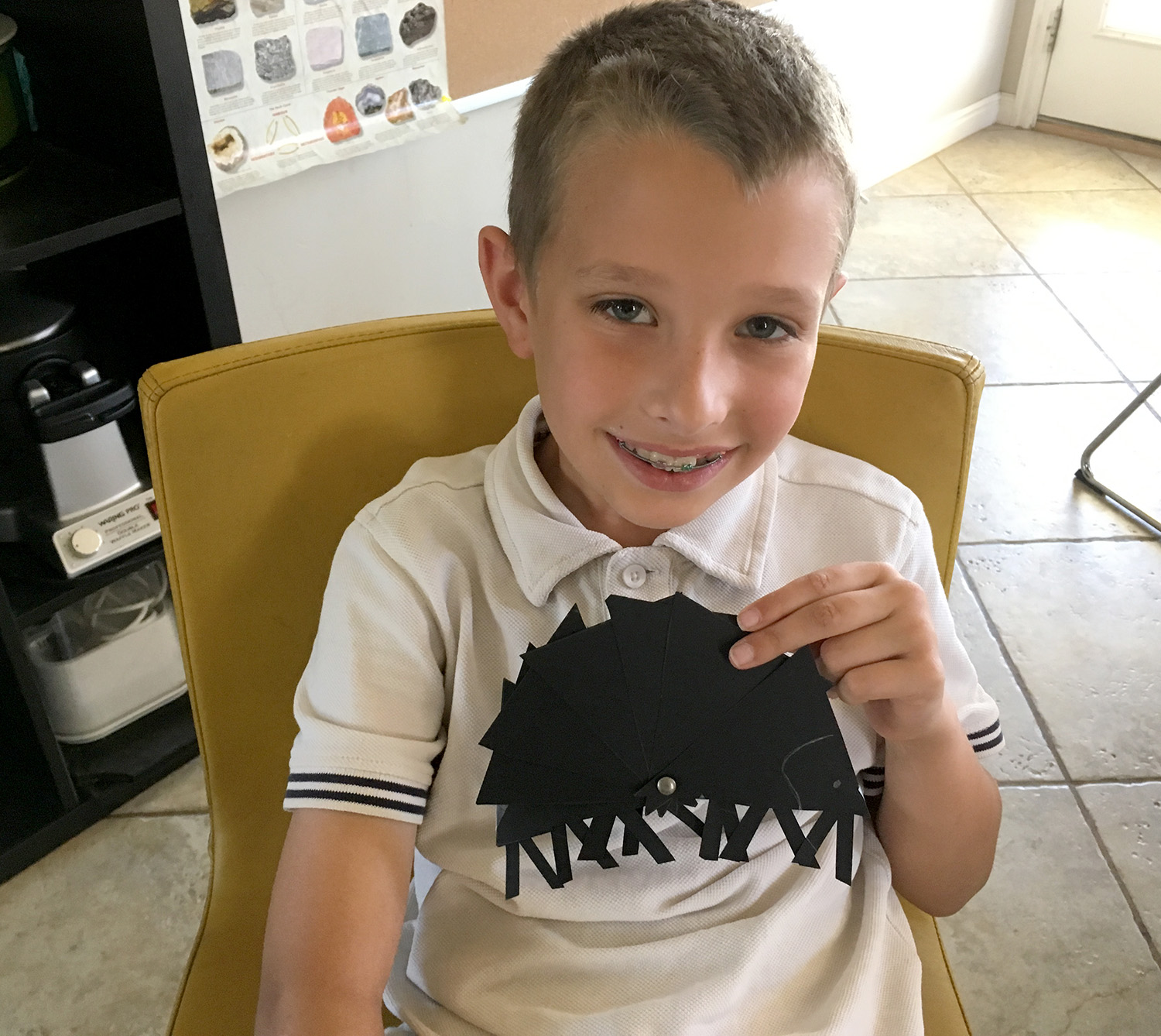
Pillbug/Roly-Poly Craft

Before we got into learning about actual insects, we spent a few days talking about things that seem like insects. Things like spiders, pillbugs, worms, millipedes, etc. I had had the "spiders aren't insects" fact drilled into me sufficiently, but I never knew that pillbugs are crustaceans (like crabs!), and it was good to review just how else these "bug-like" creatures are alike and different from each other.

For one activitiy, we made these cute little pillbugs that roll up into balls. The instructions are here, and it's fairly simple: cut seven triangles of equal size and join them with a paper fastener so the segments can slide under each other. Cute.

Tuesday, August 30, 2016

Insect Unit Schedule and Lesson Plan

Ever since we started homeschooling, I have had this vague idea that no one ought to leave school without having made an insect collection! I'm not sure why. It just seems like one of those things…one must do! So, now we have finally gotten around to it and we can just close up shop and call it good, I guess! :)

My little Juniper just started kindergarten "officially" this year (she's been hanging around while the other kids have school for a long time, of course) and this seemed like a fun unit for her to start with. There are loooooots of ideas online for "bug activities" and crafts, but most of them are geared for quite a young audience! And since we tend to do a lot of stuff directed to the older kids, it was nice to find some cute little kindergarten-style crafts for Junie's sake. Although…honestly…the older kids really seemed to enjoy the simple little crafts too. I think it's relaxing for them to just sit and make collages, or play with pipe cleaners, sometimes. I sometimes join them myself!

Fall was a great time to study insects. The weather is so lovely and mild that it's a pleasure to be outside, and the insects haven't flown away or gone into dormancy or whatever yet. And I must say our insect collection turned out way better than I anticipated. I pictured a few sad-looking bugs in a box, like I had when I was in school (although I was very proud of mine…thus my feeling that it was a "must-do," probably)—but we ordered some great supplies and got a beautiful-looking display box, and it made all the difference! Sebastian has probably been the most enthusiastic worker on the collection, and he has arranged it and made it really beautiful! So it has been fun.


We really enjoyed a series of short animated videos from a show called "Minuscule," which I think is/was a French animated show? You can find lots of them on YouTube. In fact, I tried to buy a DVD of some collected shows, but it is only made for the other kind of DVD player (Region 4 or 2 or whatever it is). But if you search for "Minuscule" on YouTube you'll find a bunch. 

Here is an example of one of our favorites, about bees, called "Le Convoi." Many, many of the others were very fun as well.

There is also a movie made by the same creators (and featuring many of the same insect characters) called "Valley of the Lost Ants." This one WILL work on U.S. DVD players and we quite liked it. There are almost no words, just lovely animation. It reminds me in tone of the documentary Microcosmos, which I saw for the first time at BYU (International Cinema!) and loved. (I think I read somewhere that the Minuscule people were inspired by Microcosmos, so that makes sense.) We watched "Valley of the Lost Ants" for our Insect Celebration at the end of the unit.
Goldie drew this darling picture of some insects :)
This chart helped us keep it all straight...
Related Posts Plugin for WordPress, Blogger...