Thursday, January 7, 2016

Weaving

After we learned about the fibers that make up different fabrics, we learned about how those fibers are spun and woven together to make fabrics. And of course, when learning about weaving, it is always fun to make paper baskets! These woven hearts are traditional decorations for Danish Christmas trees (my Danish grandmother had a whole tree full of lovely red and white ones) and, while they're slightly more complicated then just a regular double-sided woven paper mat, they aren't too hard. We had made them before so we were quite good at it! This template made them even easier.
After getting the hang of the basic "over-under-over-under" idea in weaving, we were ready to get a little more complicated. My friend let us borrow a tiny American Girl loom (I think it was for the Kirsten doll) that has a shuttle, beater, gears, and all the parts you need. That was really fun. We finally understood the warp and the weft and how the shuttle interacts with the threads to separate and lift them. Sebastian was probably the most persistent, but we all took turns weaving and making a couple of cute little woven doll sashes.
I can totally see why weaving is getting popular these days. It is really fun! Even on a doll-sized loom.

We also used my sari to demonstrate different ways that a length of woven fabric could be worn and tied and draped once it's made. There were a lot of draped styles in ancient times that didn't require sewing or much fastening at all!

Wednesday, January 6, 2016

Fibers and Textiles

Cotton?
I'm lucky enough to have a friend who spins and knits with all sorts of fibers, and she kindly let us look at several of her yarns under a microscope. Unfortunately, my notes on these pictures were a bit cryptic and I'm not sure I got them all right! I will write what I THINK they are, but you can see this page for more (and possibly more accurate) pictures of what various fibers look like at the microscopic level.
Silk?
Mohair?
Wool?
Linen (flax)?

I had a clothing and textiles class in college which was very interesting, and I had tons of fabric swatches from that, if only I could have found them! :) We raided all of our closets instead to find different fabric types, and visited a fabric store for more. The children were delighted to discover, among other things, that some of the boys' ties were "100% silk"! "We live like kings!" they said. :)

Tuesday, January 5, 2016

A Clothing History Timeline

During this unit, we put up a big timeline on the wall and wrote all kinds of things on it from other units we've had. Then we put up small pictures to show clothing from each period. That was really fun. Again, it helped us so much to visualize how the history of it all fit together! I love walking by this timeline on my way up the stairs every day and seeing the things that people have added to it. :)

Monday, January 4, 2016

Clothing and Fashion Unit Study and Lesson Plan

Click any of these 3 images to enlarge—I split it into 3 parts so the writing wouldn't be so tiny!
This looks like a monstrously long unit, and it WAS. But it was so, so fun. Sam has been wanting me to do a clothing history unit with the children for a long time now, because he says when he took his costume design class in college was the first time he really understood the whole sweep of history and how different events fit together. I can see why. The history of clothing is like a measuring stick you can use through the years to see where and why other things were happening. So, while I knew there was no way we could cover ALL there was to cover, I wanted to hit all the major historical clothing periods and get that macro/overview feeling.

My truly brilliant idea came as I was putting it all together. I decided we would watch a movie from each historical period, so we could note the costuming and have easy-to-remember references. It worked so well! If we forget what, exactly, were the hallmarks of clothing in 17th century France, we just have to think "Three Musketeers" and we instantly get a picture in our heads of what that silhouette looked like, along with some of the important things happening in that time period. (It also worked out well because this unit stretched over Christmas and New Years, so we had lots of free time for watching movies.) You can read more about our movie choices in this post.

I should stress that this was a beginner's overview of costume history. I read a costuming blog sometimes which will (quite amusingly) critique period dramas—"back lacing?! In the 1420s?!"—and I know that people much more expert than I can tell clothing trends down to half-decades and even specific years. We didn't get that detailed. Hundred-year periods, and later, decades, were the divisions I worked within, and even within decades we focused much more on broad, well-known trends and iconic fashions, rather than a true overview of all countries and social classes.

To see a visual timeline overview of clothing styles, see this post.

My Pinterest page for this unit is here.

Various clothing-related links:

Futuristic clothing with LEDs

How zippers are made

How buttons are made

Loved this article on "costume design" in Animated movies---a focus that is getting more necessary all the time, as computer graphics get more realistic!

Article about costume design in the "Pride and Prejudice" miniseries

Lots of these "Horrible Histories" clips are fun and funny. This one is on clothing laws in Elizabethan times.

This article (and whole site) is good for starting discussions about cultural ideals of beauty and modesty. The article talks specifically about the use of photoshop in print media.

More on "extreme photoshop use": here and here

We got this program, "Tales from the Royal Wardrobe," (about royal clothing through history) from the library and really liked it. She gets to try on actual clothing from those eras and you can see all the farthingales, petticoats, corsets, etc. Very interesting!

Wednesday, November 11, 2015

Making Armistice Day Poppies

Our World War I Unit happened to fall over Veteran's Day (or Armistice Day: 11/11) and we wanted to visit a veteran's cemetery. I hoped we might find the graves of some World War I soldiers, but we didn't. However, we found some WWII soldiers that had been alive during World War I. It was interesting to think about what their lives must have been like. And it was beautiful to see the cemetery all covered with flags.

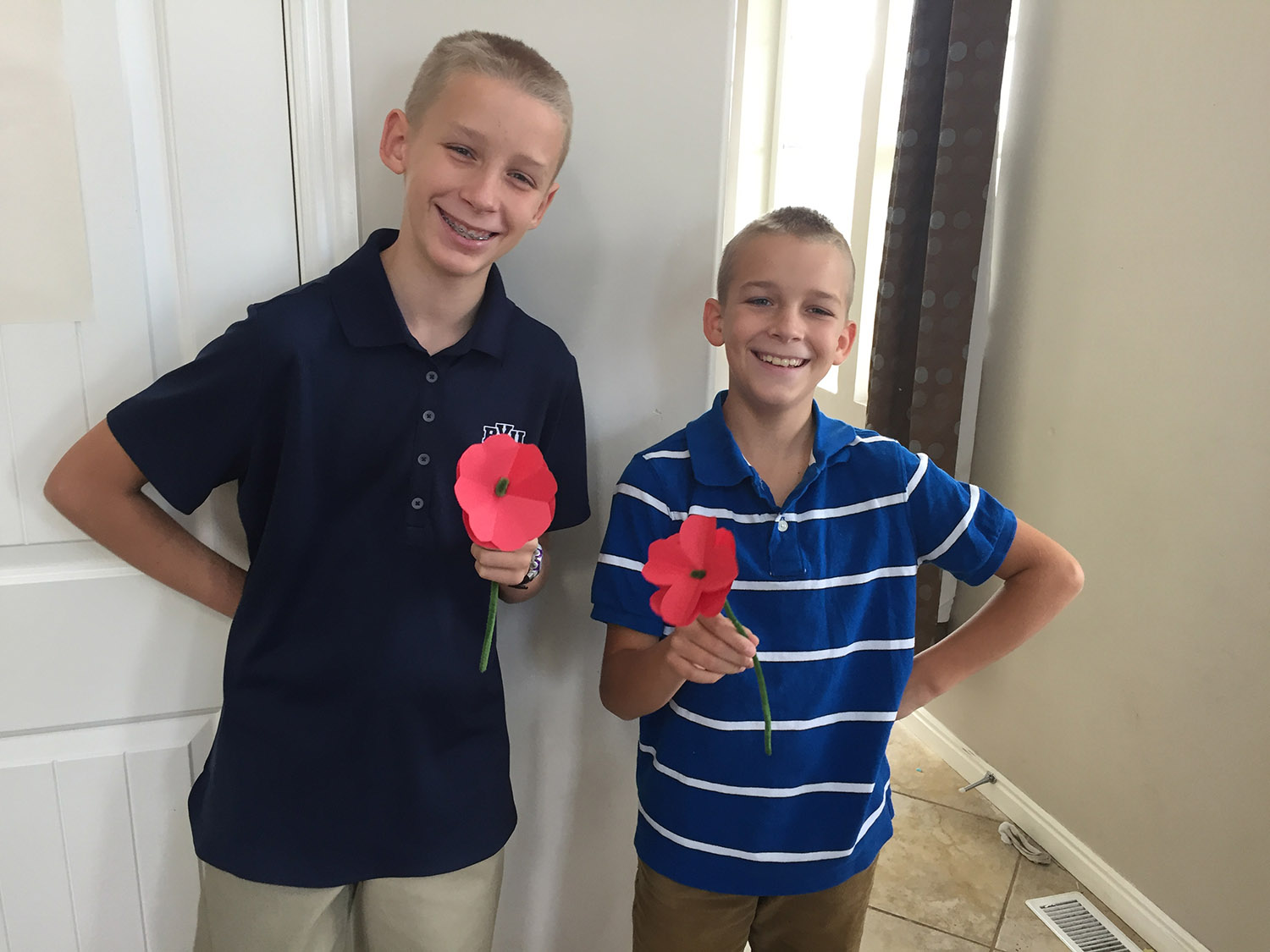
We made some paper poppies to leave on the graves, and to wear in our buttonholes. The tutorial we used is here. It was really easy and the children ages 4-13 all had fun making them.

We also watched a time-lapse video of the ceramic poppies placed at the Tower of London last year for the centennial of World War I. It's an amazing display!

And this video tells the story of why poppies stand for remembrance (especially in the U.K.)
At the cemetery we saw the grave of a young soldier who just died last June. There was a letter on the grave labeled "to my husband." It made me cry. His poor wife and family! What a sacrifice.
We're so grateful for our veterans and soldiers, and we were happy to have a chance to remember them on Armistice Day!

Monday, November 9, 2015

World War I Unit Study and Lesson Plan

This unit was shorter than I expected it to be, and we didn't take a ton of pictures, but it was a really interesting topic. I didn't know too much about World War I. I had learned about it in European History classes, but I didn't have a clear picture of what went on and I thought it was mostly just a war over…nothing. Which isn't exactly true. I learned a lot as I read and studied the historical situation in the early 1900s, and I was interested to learn how much of the "modern world"—down to even our kind of pervasive attitude of skepticism and sarcasm—can be traced back to World War I.

Anyway, my pinterest board has some good ideas for a World War I study, and I'll highlight a few of our favorite resources on this post.
We had this book from this library, and it gave us the idea for a War Censor activity. I printed out a letter from a soldier, and the children went through with a black pen and "censored out" the parts that might endanger the soldiers or otherwise prove useful to spies. They had fun doing that.
We really liked this documentary "World War I in Colour." It's amazing how seeing color pictures of the war makes it seem more immediate and real! There are six parts and we found them all on YouTube.

We made paper poppies for Remembrance Day.

This was a good short video about a (statistical) WWI mystery!

These Horrible Histories shows (find clips on YouTube) are pretty funny. Some can be crude, so they're worth previewing first. But the children could not get enough of this song, by Tsar Nicolas, Kaiser Wilhelm, and King George V. They LOVED it. 

Interesting video showing cases of "shell shock."

Here's an animated map of WWI.

We learned about the term "doughboy" and made these World War I Salvation Army doughnuts.

We read several picture books about the 1914 Christmas Truce. I cried and cried through every one of them. Such a sad and touching story! Here's a video about it.

The Zimmerman Telegram was an important factor in the United States' decision to enter the war. Here's a decoding activity we did with it.

We looked at and studied this powerful painting by Sargent.

Here are some recordings of popular music during WWI--songs like "Over There" and "It's a long way to Tipperary."

On the lighter side, we learned about Charlie Chaplin and silent films (one of Chaplin's first movies came out in 1914 and many were popular during the war). We watched some examples. They are SO funny and good. We also particularly like Buster Keaton. Here are some good ideas for movies and books to try on this topic.

Wednesday, November 4, 2015

Monkey and Ape Celebration

We had a great time with our end-of-unit Monkey and Ape celebration. All the household monkeys (and apes) were invited.
We hung up some vines (a plastic tablecloth which Seb cut into strips).
And we had a lovely monkey-themed dinner. (Don't forget the banana-chocolate smoothie! We forgot to put it on the menu, but we did NOT forget to make and eat it.)
This banana-coconut soup was really good. Interesting foreign flavors (it reminded me of the curried groundnut soup I sometimes make, which is an African recipe. This one was Vietnamese, I think). I found the recipe here. Here's another version that looked good.
I had made this style of monkey cupcakes years ago, for Seb's birthday. They're cute (although for some reason, in this picture these look to me more like dogs than monkeys!) This time I tried a peanut-butter banana cake recipe. I did plain peanut butter instead of chocolate/peanut butter for the frosting, though. 
Abe made monkey cups to hold our drinks. We found this idea here. We also printed out these little paper monkeys to cling to some bananas, for decoration.
After dinner we did some games and activities, and then watched "Monkey Kingdom." We liked it. There are lots of good monkey-themed party games—here are two.
We had an origami station. The pattern for the gorilla is here.
We made a whole troop of gorillas!
The nut-cracking station was a big hit. We cracked open walnuts and almonds the way some monkeys do it, between two big rocks! (This is another way monkeys use tools.)
Daisy-gorilla
It was a fun Monkey Celebration and a fun unit! Perfect for a family of little monkeys.
Related Posts Plugin for WordPress, Blogger...