Friday, May 26, 2017

Making and using papyrus

One thing I remember pretty clearly from my grade-school years is the time I made my own "papyrus" for a school project. I don't remember it all THAT clearly, I guess, but I do remember that I used iris leaves, and it took a lot of experimentation to get them soft enough—seems like maybe I ended up using the blender? And then baking the sheets in the oven?—and it never really turned into great paper. But it was fun, I remember that! For this unit, though, I wasn't really planning on trying to make paper because we had done it recently when learning about Japan.

But…while we were gathering the reeds for our reed boats, we found some of these nice wide-leaved water plants which seemed like they might be kind of like papyrus…because they had white pulpy stuff inside, and seemed buoyant. So, we decided just to experiment a bit.
With real papyrus, you'd scoop out the pulp and just use that for your paper, I think. But we just wove the whole reeds into a kind of mat and then pounded it with a mallet. Seb quite enjoyed that part.
It got all pulpy and you could see the fibers sort of fuse together as it dried.
And once it was fully dry, it was possible to write on our "papyrus"…though not really easy. Still, it was fun to visualize the process a little better by doing this activity.
I also ordered some actual papyrus so the children could see and feel what it was like. Much nicer than our "homemade" version, of course! And it was fun to write on it with brushes. We attempted to write our names using hieroglyphs, though the more we learned about that written language, the more we realized how complicated it was and how we didn't really "get" it with our letter-for-letter Western view of things! Still…fun to try it.

Here's an overview of the Egyptian numbering system we used, too.

Wednesday, May 24, 2017

Ancient Egypt activities for children

There are lots and lots of teaching resources for Ancient Egypt, so I didn't really have to come up with many activities on my own. One thing that was a big hit was ordering this Egyptian game, Senet. I think scholars admit that we don't really know for sure how it was played in ancient times, but they have come up with rules for it and my kids really liked it. They like board games anyway, but this was one even the kindergartner could play! It's just a two-player game (as you might not be able to tell from the picture) but it's quite fun! 
One book suggested making dried apples and talking about how much of food preservation involved salting or drying back in those times, especially in hot dry Egypt! You just cut apple slices and put them in a 200-degree oven until they look dry and leathery. Or you can use a fruit dryer. My children have done lots of fruit drying with their grandma, so this wasn't new to them, but it was kind of fun anyway. It relates sort of to mummification also! :)
But to really talk about mummification, we did the ol' Apple Mummies activity. I feel you can't swing a cat on the internet without smacking a page about the Apple Mummies activity, so I won't recap it much here, except to say that it's not the very yuckiest option you can do, so that's good. You use salt to approximate the natron Ancient Egyptians used for their mummies. Here's an alternate version of this project.
Another fun thing to try is making Egyptian reed boats. We just picked some hollow-ish reeds from a stream nearby and held them together with twist ties while they dried. They do, indeed, float! And the children liked floating little toy soldiers on them in the bath.
A lot of pyramid-building play went on during this unit, which was fun to watch!

Monday, May 22, 2017

Making Egyptian Pharaoh Death Masks

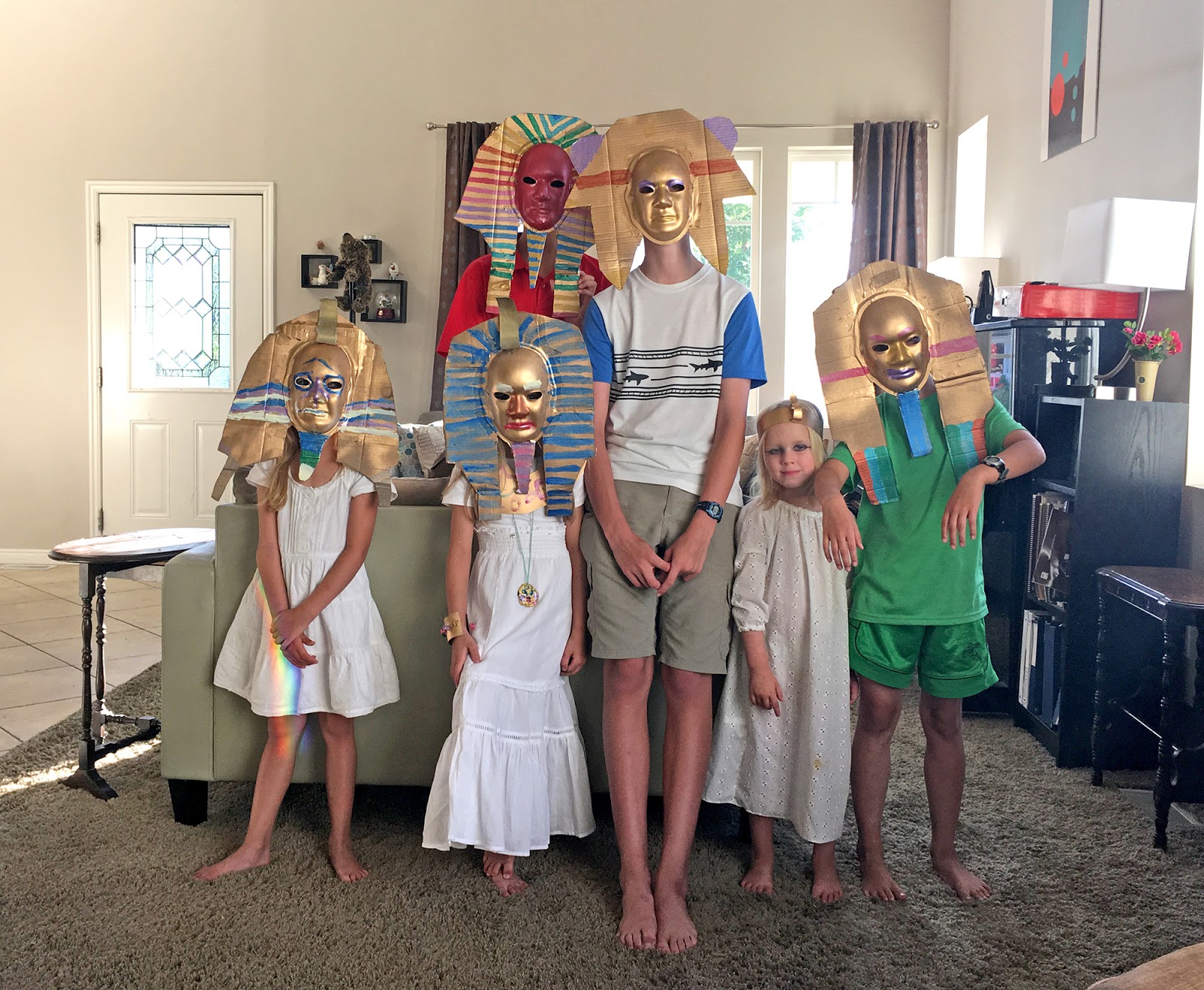
This was one of the coolest crafts we have done, I think—I mean, the final result is just so…funny and weird and impressive all at once, don't you think? I got the idea for the masks here. Like the lady at that link, I just ordered paint-your-own masks from Oriental Trading Company (find them here) an the kids spray-painted them gold and then painted with acrylics on top of that.

I had just torn a couple of ligaments in my foot the day before we did this project, and I couldn't even walk or get out of bed at the time, so I literally sat in my bed and helped the younger kids cut the cardboard, and then left everything else up to them. (This picture was taken a few weeks later.) They did an awesome job.
Junie scared the daylights out of me by standing next to my bed in the morning and I woke up with THIS FACE starting down at me. Terrifying but also somehow…awesome? :)
If you don't want to do the masks, you could also do this craft that lets the child's face show through. They are cute too. As shown here,

Monday, May 15, 2017

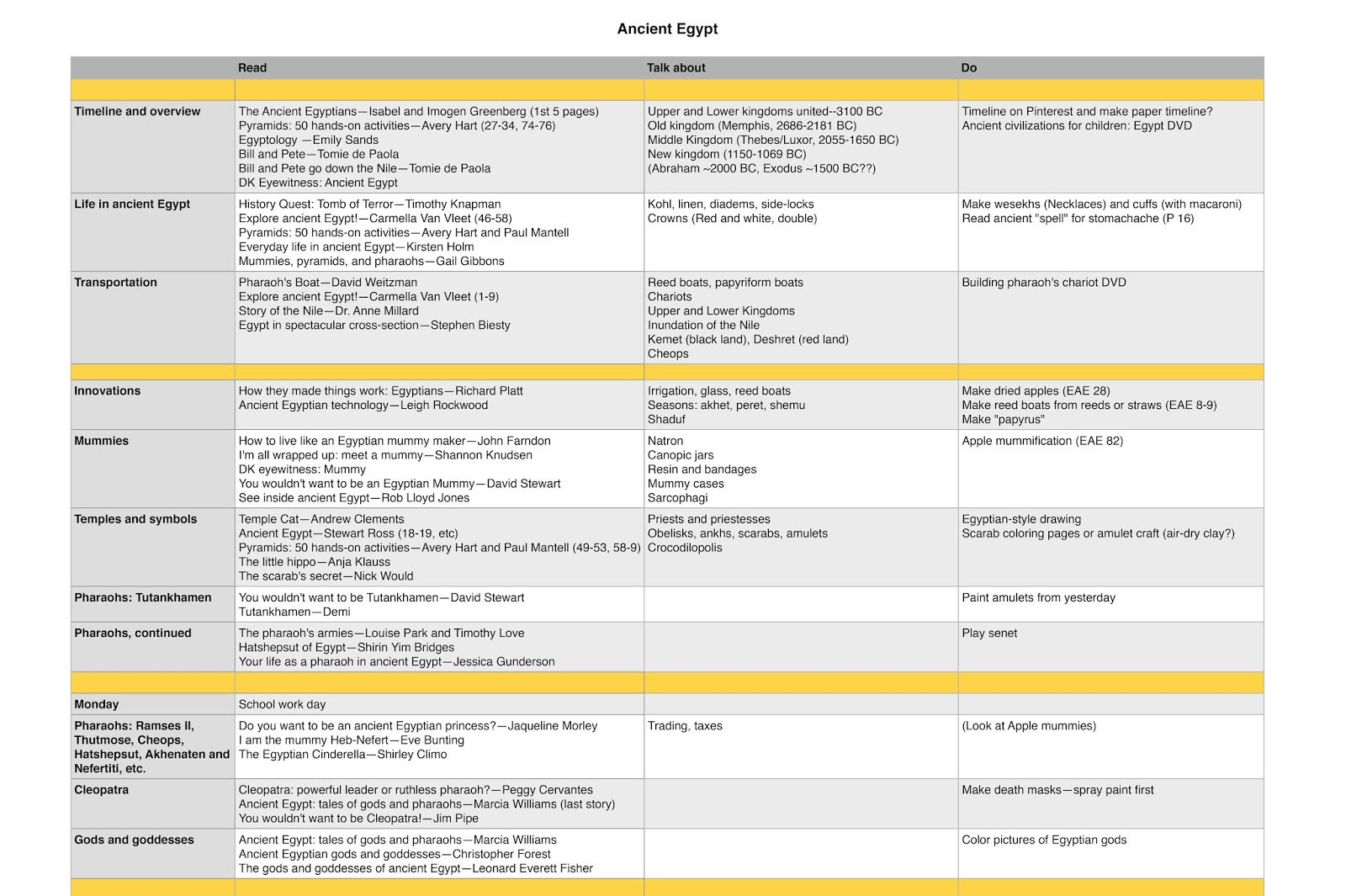
Ancient Egypt Unit Study and Lesson Plan

click top or bottom section to enlarge
I wish we could have had my Aunt Kay here to be the guest teacher for this Ancient Egypt Unit. She's an Egyptophile who has read and studied so much about that ancient culture, and she's been there (to Egypt, I mean…not to Ancient Egypt…that I know of) and she has so many cool things in her house she could have showed us. But I did write and ask her for book recommendations, so that was helpful at least.

And…ahem…I too am a bit of an Egyptophile, ever since the Rameses II exhibit came to BYU when I was just a youngster, and my mom was a docent for the exhibit. I still remember how much I loved going into the old Monte Bean Museum (remodeled for the exhibit, and almost unrecognizable inside) and peering through the mysterious low-lit rooms to see mummy cases and jewelry and scarabs and (my favorite) a goat-handled drinking vessel. It was all so fascinating! I remember getting to write a cartouche of my name in hieroglyphs, too.

There is A LOT to learn about Ancient Egypt, and each period in that impossibly-long 3000-year (!!) civilization has its own characteristics, so, as always, I feared oversimplifying or leaving out essentials. But you have to start somewhere, I guess! And we loved what we did get to learn. (And I finally mastered how to spell "Pharaoh"! Man, that word is hard to spell. I've always struggled with it.) 

Here are some general Egypt links:


Egypt coloring pages here and here

Cool high-definition scans of sone of the Joseph Smith papers Egyptian Papyri

Ancient Egypt Timeline and list of dynastic periods

Another simple illustrated timeline


And another good article and background on Joseph Smith's collection of Egyptian papyri.

Wednesday, April 26, 2017

Gem Institute and Music Museum Field Trips

Since we were going to be in Carlsbad for the Flower Fields, we set up field trips at the Gem Institute and the Museum of Making Music while we were there. Both places take homeschool group tours, but you have to schedule in advance. At the Gem Institute you have to go past the guard booth and show your ID, which makes you feel kind of important. The tower on the front of the building has this beautiful sparkling crystal in the top.
It's not a huge museum, and none of my pictures are very good, but we loved seeing all the beautiful minerals and gems! This crystal pendant was hanging in the front window, and what you can't tell from the picture is that it's HUGE—probably as tall as Daisy. There are beautiful colored inclusions in the quartz, and when the sun comes through, it makes rainbow patterns on the walls and floor.
They did have some things the kids were allowed to touch. Hooray!
There were some interesting works of art made from gemstones—carved pieces like these, and others.
One of my favorite things was this display of orchestral instruments, all carved from precious stones.
I loved this. It's called Ametrine, and it's only found in one area of the world, where the minerals amethyst (the purple one) and citrine (the yellow one) occur naturally together. The sign said that at first, gemologists usually cut and faceted the stones with yellow on one side and purple on the other, but now they've found ways to cut them where the two colors join and blend, to give a more modern, free-form look. Aren't they all beautiful?
We always love malachite!
The display of opals was really beautiful. The museum had a birthstone exhibit that these were part of.
A rainbow of gemstones! I'll take one of each, please.

Our next stop, the Museum of Making Music, was great too. We had a whole tour and class, led by Mr. Bill (or Mr. Bob? or something like that) who was such a nice, friendly man. (He seemed greatly disappointed in us when none of the kids had heard of Elvis Presley, though.) First he had us sit in a drum circle and let the kids take turns conducting us. Adam LOVED that, as you can see.
So did Ben.
So did Daisy!
And at the end of the museum tour, there was a room with a whole bunch of different instruments the kids could try out! It was a little nerve-racking for Allison and me, keeping track of all ten of them and making sure no one dropped or broke anything, but the kids loved it!
Note Teddy in background, waving a zither or some such thing around
This was a great culmination of our Sound and Percussion Unit!

Saturday, April 15, 2017

Field Trip to Rosewood Recording Studio

Because I am lucky and I have the most awesome friends, we were able to take a field trip to Rosewood Recording Studio during this unit. I've known the Randles since high school (they were part of my inspiration to homeschool our children, in fact) and they are the nicest, most interesting people you could hope to meet. Guy gave us a great introduction to sound basics and then showed us how he mixes and captures sound in his studio. He even recorded the children singing and then showed them how he could isolate individual voices, slow down and speed up different tracks, add customized reverb profiles, etc. They LOVED it!
The dogs were very friendly too.
It's such a cool studio, full of so many cords and microphones and instruments!
Doesn't it make you want to play some music?
And Kristen even took us to visit her horses afterwards. Such a fun day!

Monday, April 10, 2017

Percussion

Ever since I was in high school, playing in a percussion ensemble of my own, I have loved going to the BYU Percussion concerts, and I've always wanted to take my children to one! The college has added a group specializing in Eastern music since I was there, and that is really strange and interesting (though the regular Percussion Ensemble is still my favorite). The steel drums group, Panoramic Steel, is always really fun too.

So, we made sure to schedule a field trip to the "Evening of Percussion" concert during this unit. We loved it! And the children were using my mallets and drumsticks to drum on everything for the next few weeks…but that was inevitable, of course. :)

A few other percussion-related resources:

This is an interesting video about a day in the life of a symphonic percussionist

Demonstrations of how to play African log drums.

We looked up videos of pretty much every percussion instrument on YouTube, just so we could hear what each one sounded like. It's interesting to hear the difference between a marimba and a xylophone, for example, or glockenspiel and celesta.

Here's a sample of a piece written for water percussion

You've probably heard of this percussion group called "Stomp." They create percussion music with all kinds of "junk" like garbage cans and brooms, and with their bodies too. We watched a couple videos of this and the children liked it. (I played a percussion piece in high school where we just clapped, drummed on our knees, stomped, pounded on our stomachs, etc. to create the music, and I thought it was the coolest thing ever!)

Have you heard this piece by John Cage for prepared piano? So weird and cool. I've always wanted to play something for prepared piano.

And of course, there's also Cage's famous piece 4'33", which consists of 4 minutes and 33 seconds of just…silence. Or rather, all the ambient sounds—people coughing, programs rustling, etc—ARE the music. It's one of those avant-garde concepts that cause lots of arguments about "what is music"—but you can't argue that the idea is interesting! I've always thought it would be fun to hear this one performed live.

Carl Nielsen's 5th Symphony has a really cool snare drum part—the snare drummer is basically directed to "fight against" the conductor of the piece in one section. The drum part calls for wild, ad-libbed drumming, even playing in a different time signature than the rest of the orchestra, and without regard to what the rest of the musicians are doing. It's a symbol of war and chaos. Eventually the drummer is "defeated" by the rest of the music and goes offstage, still playing. You can read descriptions of the piece here and here. And you can listen to it here (for that crazy snare drum part, start at about 15:40)

And here is a video of the children drumming on the couch and other things. They really love doing this and they love watching videos of themselves doing it. :)

Wednesday, April 5, 2017

Field trip: echoes and pyrite in Ophir Canyon

One of the things I found most interesting in this sound book I read was the way the author talked about listening—really listening—to the sounds around us. He talked about how different places in the world have distinct sonic characters in the same way they have distinguishing visual characteristics, and he described having his students go on "sound walks" while blindfolded, so they could experience a place acoustically, kind of like you'd do a "nature walk" to see birds or something. This seemed like the coolest idea to me! So we tried it in various places: near a busy construction site, in our neighborhood, in a downtown area, and then in a more remote country area by my friend Cathy's house. The sounds in each place were so different! It made me think about how much the sounds are part of the experience when we go camping, or hiking. It's so peaceful to be somewhere where all you hear is wind and birdsong!

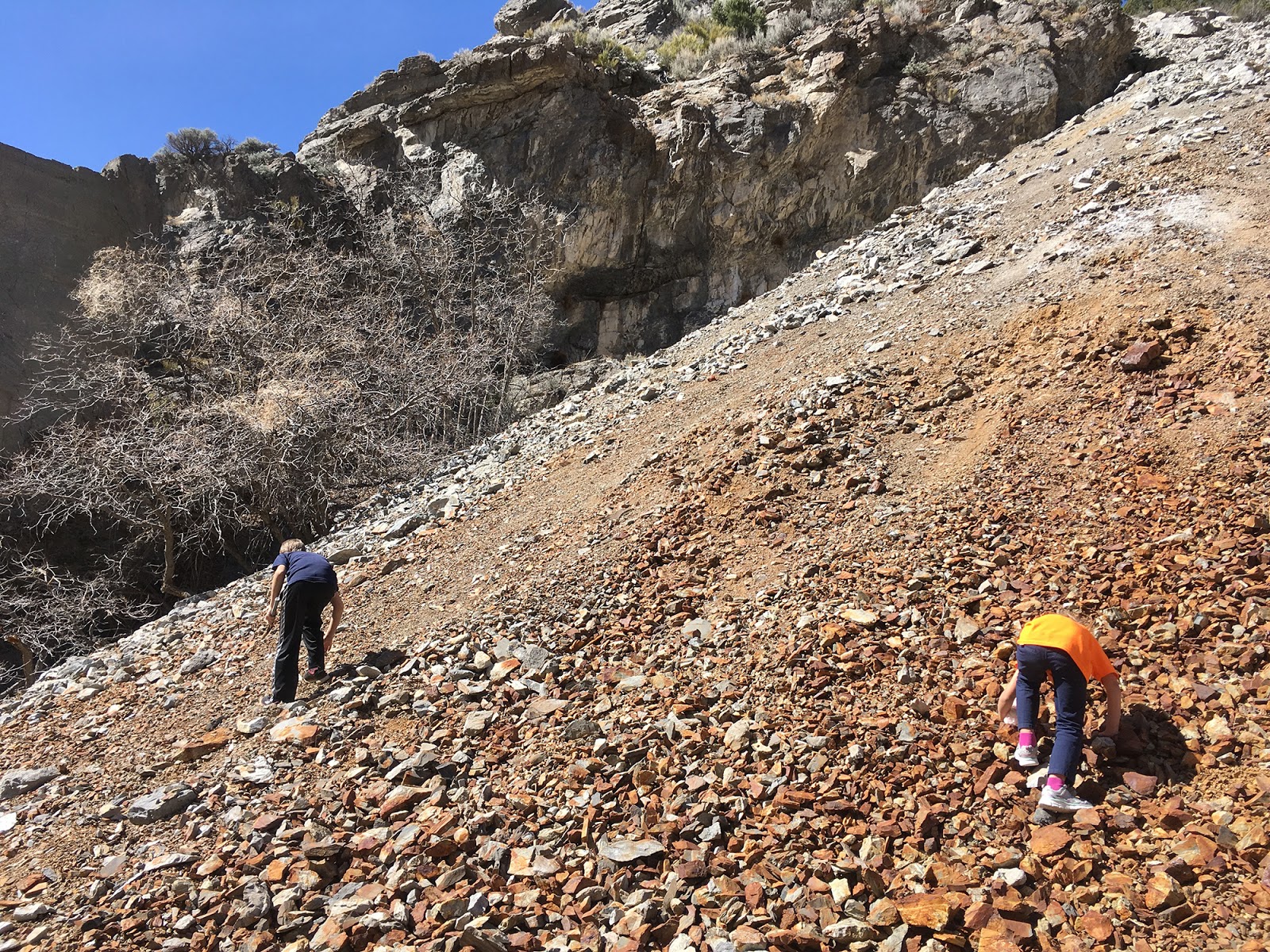
While we were in Tooele County, we went to a place we'd been wanting to go: Ophir Canyon, where our rockhounding guide assured us there is pyrite to be found! We always welcome the chance to find cool rocks, and this was a really easy site because the roads getting there are all paved, and you can find all kinds of pyrite just in the pile of mine tailings by the road!
Teddy got one of the rocks and walked around talking on it like it was a phone. Very businesslike.

And, as an added bonus for our Sound Unit, we discovered some great places to hear echoes in this canyon! You can hear them in this video:

Monday, April 3, 2017

Anechoic and Reverberation Chambers field trip

When I was little, my dad would sometimes take me over to the Science Building where he worked at BYU, and show me all the coolest things: the top of the pendulum, the giant ground sloth skeleton, the wave machine, and best of all the anechoic chamber. I LOVED going into this room where there were no echoes, no outside sounds—only the most silent, muffled air I'd ever experienced. And I would have given anything if, for this field trip, I could have just called up Dad and asked him to get out his key and go with us to the anechoic chamber again! But…now that he's gone…we had to go through the regular channels. And it wasn't too hard: you can just sign up for a tour here at the BYU Acoustics Outreach page. On the night we went, we were the only people in the group, so it was great.
The anechoic chamber has been remodeled since I was young: back then it was all made of yellow insulation, and the foam pieces weren't quite so aggressively triangular! So it was cool for me to see this updated version. Our tour guide was really knowledgeable and answered all the children's questions with great patience. (The little ones were kind of nervous about the wire mesh floor, and I remember feeling just the same when I was young! It feels very precarious. It's actually strong, though—they can put a grand piano on it with no problem!)

My only regret on this field trip was that I didn't get to walk around yelling and shouting with as much wild abandon as I felt like I could when I was there with my dad. :) And I wish I had thought to make a recording while we were in there! But, never fear: here is a recording made in another university's anechoic and reverberation chambers which will give you the idea.

Another bonus was that, unbeknownst to me, BYU now also has a reverberation chamber, which is basically the opposite of the anechoic chamber. And that was really cool too!
You can see all the hard angled surfaces they have hanging above the floor, all to increase reverberation.

The most amazing thing in this room was the demonstration our guide gave us of standing waves. He turned on a loudspeaker that put out a loud, low sound, and then we walked around the room listening. Because of the reverberation, the waves reflect back on themselves, and that means they sometimes make nodes, or places where the peaks and troughs of the waves actually cancel each other out. We had understood this in theory, but experiencing it in real life was really striking! You'd walk around, wanting to cover your ears because of the loudness of the sound, and then suddenly you'd come to a spot where the sound just…dampened. It became almost soft, as if you'd covered your ears or walked into a different room. And those places were the nodes. We loved this!

I didn't record that phenomenon, but here is a short sample of how a voice sounds in the reverberation chamber: 
Related Posts Plugin for WordPress, Blogger...