Showing posts with label volcanoes. Show all posts

Wednesday, July 23, 2025

Volcanoes and types of lava

Surely every child loves to learn about volcanoes! The rice crispie volcano models are always a hit.
Stratovolcano inside
Viscosity of lava—the amount of gases each type will dissolve determines that lava's characteristics.

Monday, September 23, 2019

Volcano Activities

We learned about volcanoes (briefly) and did the usual activities. Of course, my kids love volcanoes—who doesn't? We didn't go as in-depth as we sometimes have, but we covered all the basic types of volcanoes and how they are formed. (Above you see a cinder cone…made by blowing sugar into the air with a straw and letting it settle into a cone shape).

My very favorite thing was going to see this IMAX movie about volcanoes. If you ever get a chance to see it, make sure you take the chance! It was so cool! You feel like you are IN a volcano, or walking around one—which I have always wanted to do. And this wasn't even dangerous. :)
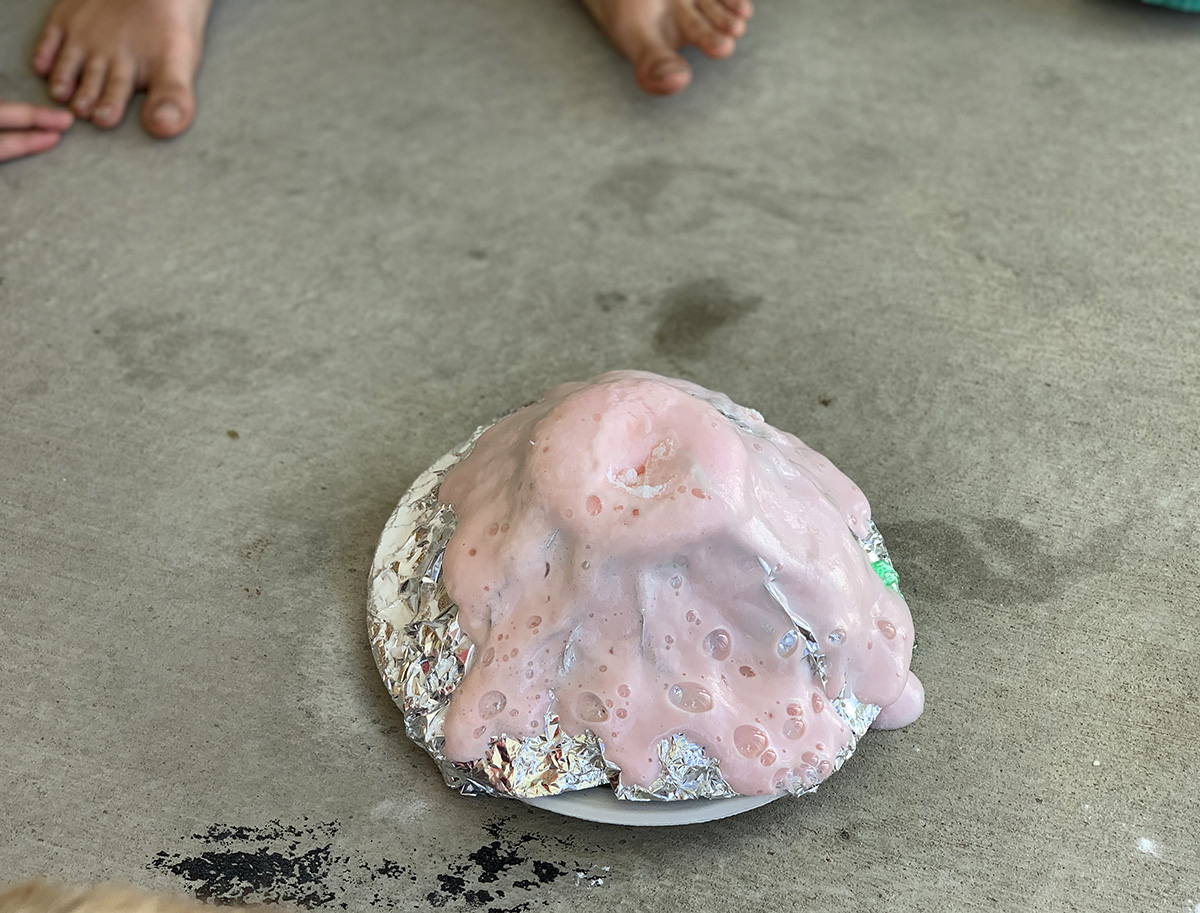
Vinegar and baking soda volcano
Rice crispie stratovolcano—alternating layers of cinders and pahoehoe lava (rice crispie mix) and liquid a'a lava (melted chocolate chips).
This must have been a very explosive eruption!

Monday, May 16, 2016

Igneous Rock

We have done a lot with rocks and the rock cycle before, so we didn't go all-out with it this time. There are tons of fun activities to do, though—igneous fudge, the chocolate rock cycle, and geologic brownie sundaes, to name a few. :) This one is similar to the "igneous sugar" activity we've done before, and demonstrates how crystal formation is aided by greater periods of time and warmer temperatures.

Sugar that cools very quickly forms very small crystals, or no crystals at all. To demonstrate, you melt sugar with a little water in a pan until it is just golden brown. Then pour the molten sugar in a very thin layer onto a pan you've had in the freezer. The sugar will cool almost immediately into this smooth, glassy substance, similar to the way obsidian or volcanic glass forms.
It's really quite beautiful.
On the other hand, if you make a supersaturated sugar solution that will cool very slowly (put it in a tall jar or glass, with a lid if possible), the crystals will have time to grow in a much larger and more definite form.
Like this. Ours took days and days to cool, so be patient! :)

This was a demonstration of how different types of magma flow at different speeds. The viscosity of magma affects what types of volcanoes will form in a particular location. We talked about this more during our volcano unit.

Tuesday, May 10, 2016

Plate Tectonics, Composition of Earth

We made these books to show the composition of earth: core, inner and outer mantle, and crust. We got the idea here (scroll down), and there's another cute option here. The children quite liked sewing the binding down the middle—they were so surprised at the idea of sewing on paper! :)

Somewhere (where??) we got the idea to use graham crackers on top of peanut butter to model the way the tectonic plates move over the mantle. We used these models to demonstrate the types of faults and plate boundaries. Above, a divergent plate boundary (note the magma welling up in the center to form new crust).
If you take an eye-dropper and wet the graham crackers along the edges, and then push together very slowly, you get a very nice convergent plate boundary (and some fold mountains).
Plate subduction. The lower plate slowly melts and returns to the magma from whence it came.

Because we are nothing if not thorough, we also modeled this process with two pieces of Milky Way bar. This worked better in some ways because it showed how widespread the faulting can be at a plate boundary. It's not usually just a simple uplift in one spot, forming one mountain range. There are cracks and faults in other areas throughout the crust as well.
Someone made a very nice mantle plume which then seeped up between plates to make a volcano. :)

And, lastly, our marshmallow earth models: cut a slit in a marshmallow and insert an M&M candy (represents the inner and outer core of the earth). The marshmallow is the squishy mantle. Dip the marshmallow in melted chocolate and let it harden to form a crust. Yum!

Thursday, June 4, 2015

Animals of Japan; Geology/Geography of Japan

We watched several "travel video"-type movies about Japan during this unit, and our favorite was probably this one from "The Little Travelers." It's made from the viewpoint of two little girls traveling (alone, they make it seem like) around Japan. Daisy and Junie especially liked it. There are funny parts where the little girls try new foods or play with other children, and it just gives a feel of "this is real life in Japan." It was cute.

We talked a lot about Japan's geology, since it is so exciting! Hot springs, volcanoes, earthquakes, tsunami…all things the children are interested in. We had watched some videos of the 2011 earthquake and tsunami during our Natural Disasters Unit (you can find links here) so we looked up those and watched some of them again. The power of those huge waves is truly amazing.

We also thought the pictures of the earthquake's aftermath, here, were very interesting.

Here is an episode of Begin Japanology about Japan's volcanoes.

The children, naturally, also loved learning about the Shinkansen or bullet train. They've loved all kinds of high-speed trains ever since learning about them during our Train Unit, but we talked more about the TGV than we did the Shinkansen at that time, so it was fun to learn more about this specifically Japanese innovation. We learned that the Shinkansen was developed by a man who made kamikaze fighter planes (with no landing gear, but with streamlined fronts suited for dive-bombing ships) during World War II. He used the streamlined nose designs from the planes to inspire the distinctive front end of the Shinkansen. This was a good video about the Shinkansen, and this video about how the workers clean the trains in only seven minutes was interesting too.

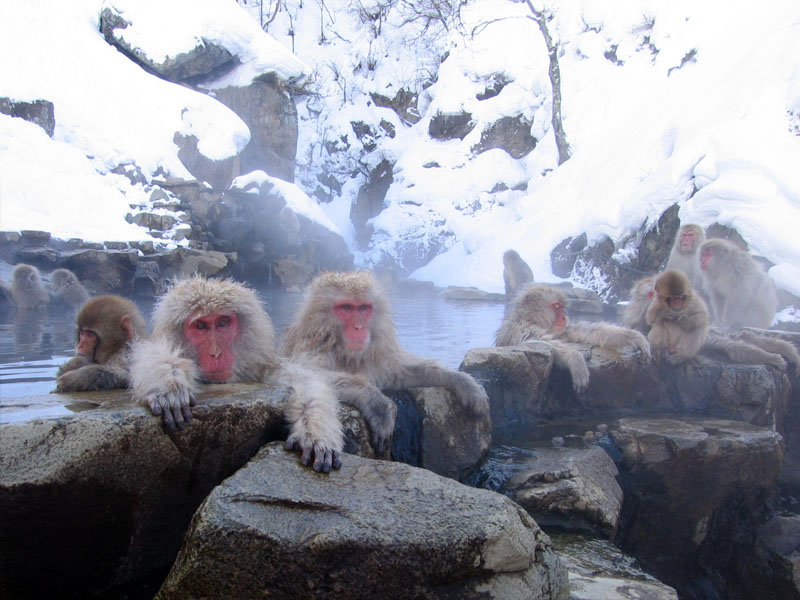
Japan has many interesting animals, but we were most interested in a couple specific ones: the Japanese Macaques or snow monkeys (the ones that like to sit in the geothermal pools—we're always seeing pictures of them) and the bunnies of Bunny Island.

We quite enjoyed this movie about the Snow Monkeys. It's your typical kind of nerdily-dramatized nature documentary (narrated by Liam Neeson). Be aware that does show some monkeys mating. And a baby monkey dies. :( But the monkeys are so cute! We loved them.

Speaking of monkeys, my friend Carrie Ann told us about her visit to this monkey park near Kyoto. It was in one of the travel videos we watched too. It looks so fun! We would love to go there.

Bunny Island is a tiny island in Japan where there is a huge colony of semi-tame rabbits. They think some rabbits were maybe left there by schoolchildren a long time ago, and then multiplied? Here is some of the story behind it. It looks like a place I would love to visit. So many bunnies! There are lots more pictures and videos:  Here, here, here,  here and even more here.

Thursday, December 12, 2013

Wildfires and Lightning

Here are a few resources for wildfires and lightning:

In the past, we have had fun making "lightning" with balloons and light bulbs (as described here and here)

These videos here and here and here show a phenomenon called a pyronado or a fire tornado. We'd never heard of these before, but they are amazing! They are formed by convection currents, just like real tornadoes, but these currents are made by the fire itself rather by storm clouds. Really cool!

A video about volcanic lightning

Information on ball lightning (video quality here isn't that great, but we just don't have that many instances caught on video, I guess!)

The picture above is our little demonstration of how a firebreak works. You fill a pan with little pieces of crumpled-up toilet paper. Make a ditch in the middle. Then spray the toilet paper with food-colored water. You can watch the "fire" (red water) spread slowly through the toilet paper around it, but where there is no paper for it to spread through (the trench), it stops. This is the same way a firebreak (a ditch or other area cleared of trees and brush) stops a fire---if there is no fuel for it, the fire cannot spread.

Tuesday, October 9, 2012

Volcanic stock (Shiprock)

We were excited that we were able to see Shiprock, a stock that formed inside a massive volcano, on our drive to New Mexico. All the surrounding rocks have weathered away, leaving Shiprock to loom over the landscape alone.
We could see the dikes (the dark rocks sticking up in the foreground) that had formed like rays out from the center of the volcano as magma forced its way upward through cracks in the earth. Sam taught us about these landforms during our volcano unit, and it was really cool to be able to see them in real life!

Sunday, September 30, 2012

Pahvant Butte volcano

I was reading up on volcanic activity in Utah on this site (great site, by the way) and discovered that there are several volcanoes (relatively) close by, in the Black Rock Desert. We set off to see what we could discover, armed with not much information. We hoped we would recognize what we saw, since there are no state parks or informational signs in this area. We looked first for Pahvant Butte, which was a volcano that erupted within Lake Bonneville. It was quite easy to recognize, with its distinctive (and large) eruption crater on top! It must have really blasted out with a lot of force, like Mount St. Helens!
On the way we passed this small cinder cone, which I think is the one called Tabernacle Hill? We wanted to go explore it also, but, as you will see, circumstances did not allow this. (*Ominous music*)

We also passed this very cute mother cow and her calf.

As we got closer we began to see lots of lava flows and lava rock scattered around everywhere! It was really interesting to see the way it extended from the volcano. Several places looked like they contained projectiles (lava bombs) from the volcano. We had read that there would be pahoehoe lava flows, but we didn't find anything that looked exactly right.

The layering in the volcano was quite fascinating!

But its most distinctive feature is called the "lace curtain." Because this volcano erupted in the lake, it was subject to wave erosion. This north side in particular was hit with heavy storm waves, and they carved out the rock in these strangely delicate, lace-like formations. There are all sorts of holes and crevices to climb around in, and the sheer scale of the formation is amazing---there are tremendously tall cliffs, all carved out in this intricate way. It is beautiful! We can't believe there isn't a state landmark or some sort of . . . something . . . to draw attention to this place!

More of the lace curtain:
Isn't it amazing?
Up close, it was even more interesting---so many fascinating little holes to explore!


I should perhaps have mentioned that this place is out in the middle of nowhere. Really. There was nothing, nothing, nothing around, as you can see:
As we drove up to the butte, we were on a dirt road, but it was well-maintained and we had no trouble on it. The road branched several times and we didn't really know where to go, so we headed up as close to the volcano as we could get, and eventually the road became too bumpy for our car, so we stopped to get out and hike. Sam decided to turn the car around so we'd be ready to go. It was a one-lane road and as he tried to turn, he had to leave the road, which was a mistake. The ground was really sandy and the tires sank in almost immediately! We pushed and pushed (Sam and Abe and Seb, while I tried to steer) but we couldn't budge the car one inch. It was awful. But thank goodness we had our phones, and cell phone service! We would otherwise have had to walk the 20 miles or so to the nearest town . . . such an awful thought. We were able to look up a towing place in Fillmore and find someone there on a Saturday. We tried to describe where we were, which was difficult.

So, that was stressful. Sam and I both felt bad that we hadn't done . . . something different (backed the car up instead of turning around?) and we were worried that the tow truck wouldn't be able to find us. But on the upside, it gave a long time to hike around and explore the area. We luckily had some apples in the car (we had certainly not planned to be out this long!), so we gave everyone some fuel and continued the adventure!
Can you find the intrepid explorers in this picture?

Our hero, the tow truck driver, finally found us after much phoning back and forth. The sun was just starting to set and I was praying my heartfelt thanks (again!) that this whole thing hadn't turned out so much worse. What if we'd had to try to get out of here in the dark?!

The children would have been happy to stay forever and play in the dirt. It was a great place to play!

The sunset light was very beautiful:


And the children were beside themselves to get to see a real tow truck in action! It was so exciting!
And we're out! Abe checks out the cavernous hole our car was in. (Our engine was resting on the ground. That sand was deep!)
We got on our way as the sun went down over the desert.
So beautiful! And we were so grateful that our car was okay (once it was out of that hole) and that we had the nice tow-truck man to lead us back to civilization!
And the full moon was coming up over the volcano.
One last look back at Pahvant Butte---you can really see the blast crater clearly from this angle.

And that was our fun and eventful trip to the Black Rock desert! We hope to return someday to explore some of the other geologic sites here, including lava tubes and several other volcanic landforms!
Related Posts Plugin for WordPress, Blogger...