Showing posts with label pioneers. Show all posts

Tuesday, July 23, 2013

Civil War Era toys---Weaving and "Yama Man" yarn doll


Here is a fun toy to make when learning about children in "the old days"---pioneers, Civil War, etc. The boys did this in their 4-H Club with my mom. We have always called this kind of toy the Yama Man---I think that's a name my Nana made up for these little yarn men. We even have a song to go with it:
The Yama yama, the Yama Man,
He will catch you if he can.
So run for your Mama,
'Cause here comes the Yama,
The Yama Man.

As you can see he is easy to make. Just take a long piece of yarn and loop it back and forth until it's a long bundle (cut the ends so there are no loops). Tie the bundle at the top.

Then do the same thing to make a slightly shorter bundle. Tie it at top and bottom, then insert the short bundle through the long one to make the arms. Tie the long bundle above and below the arms (neck and waist).

Next, separate the bottom of the long/vertical bundle into two legs, and tie each at the ankle.

You can stitch a little face on him if you want.

Or you can make a Yama Mama instead---just don't tie off the legs; it will be a skirt instead.

We also did weaving on top of cardboard squares and made little mats.

Monday, July 15, 2013

Dipping Beeswax Candles with Children

This was another of our "daily-life-in-Civil-War-times" activities. Dipping candles is really fun. We weren't very well prepared for it because I didn't have a nice long, thin-but-not-too-thin glass contained to dip from. We tried a quart jar first, but I didn't have enough wax to fill it all the way, and then we used this old vase, which was too narrow and made the wax cool too quickly. I actually had bought a tall, thin drinking glass at the thrift store for this very purpose, but although it was on my receipt, it somehow never made it home with me. I must have left it at the checkout register. Grrr, I hate it when that happens! (It was only 50 cents and I didn't realize I didn't have it till a few days later, so it didn't seem worth going back for.)

We did have a lot of fun anyway, though, and the boys were SO proud of their beeswax candles. They looked great and burned very nicely too. We burned them at our end-of-unit celebration dinner.

Here are two good overviews of how to dip candles with children:
This one uses crayons for color
and this one leaves them off-white, like ours.

Monday, July 8, 2013

Quill Pens and Berry Ink

During the Civil War, quill pens were still a common writing instrument. Metal nibs were used sometimes too, but quills were cheap and convenient, and ink was often made out of berries. So we decided to try our hands and making and writing with quill pens.

First we made our ink. I had a few strawberries that had gone bad which I saved just for this purpose (I suppose I would have used good berries if we'd had to, but it would have been sad to waste them). We just followed the recipe here: crush some berries and strain the juice into a bowl, then add a bit of vinegar (to set the dye) and salt (so it won't spoil if you keep it around for awhile).
Nice and squishy
Berry ink!

There are a lot of ways to cut quills, some more complicated than others. You can heat up some sand and stick your feather in it to harden the end, which apparently achieves good results, but we didn't bother with that step. Therefore, when we tried to cut our quills like this, they just sort of chipped off or got crushed. But the simple method, of just cutting the shaft of the feather off at an angle, worked just fine for our purposes.

Before we used our pens, we talked about how important handwriting was in those days, and how people would sometimes hire scribes to write their letters for them. We talked about how the mail system changed during the war, and the prevalance of letters for disseminating information. We also looked at lots of handwriting samples. I just love the fancy script the best calligraphers used!
Here is a handwritten letter from a Civil War Soldier
Here is some lovely fancy penmanship (the flourishes are my favorite)
Here is one alphabet (I tried to copy this font style with my quill)


Even Junie and Daisy really loved sitting down with a quill, dipping it in a little "inkwell," and drawing with it. Here are some things we wrote and drew with our quill pens and berry ink:
Ha, I always want to sign letters like this

Friday, July 27, 2012

Wheeler Farm

Wheeler Farmhouse

There are probably dozens of good Utah Heritage places we could have visited for our Pioneer Unit field trip (This is the Place monument, Antelope Island, Kearns Mansion, etc.) but we have seen the signs along I-215 for Wheeler Farm and have always wondered what it is. It's a great place to visit---you can go walk around the grounds and look at the animals, feed the ducks, etc. for free. For $2 a person, you can have a wagon ride and a blacksmith demonstration and make butter and have a guided tour. That's what we did, and it was really fun. We also got to milk a cow---something I have (go ahead and laugh at me, farmers) always wanted to try. It just seemed like an experience one should have! So I was very pleased to get the chance. I'd heard you have to take a while to get the hang of it, but Jessie (our cow) was obviously totally used to this and we barely even needed to squeeze her udders to get the milk to squirt out. I thought it was really cool and so did the kids. Even Daisy, once she got past the fact that cows are HUGE!
It was such a hot, hot day. I had been sick and I had a fever, so I honestly thought I was going to pass out from the heat. When we got home into the cool house I declared we would have root beer floats for dinner. And we did.

Gosling!

Pink cheeks

The only bad part was the flies. So many flies! Yuck!

This was a cool little tree house the kids could play in. There was another little play house over by the river. This would be a great place to come with a picnic---we will have to come back!

Thursday, July 26, 2012

Pioneer toys and games

I wanted to try making handkerchief dolls, using this tutorial---although I wasn't really sure if the children would like them that much---because it seemed like such a good demonstration of using what you have creatively, and being happy with it! We talked about how kids have always been able to make toys and games out of whatever they have---which the boys can definitely relate to, being the kings of stick-games and rock-games and whatever-else-they-find-games. Anyway, the dolls looked easy enough, and since I didn't have any handkerchiefs around (my Dad used handkerchiefs, though! I can still remember my mom teaching me to iron, using his handkerchiefs, when I was about Malachi's age) we used dishtowels.

We left off the lace borders on the dresses, so the only really tricky part was embroidering the faces on. I'd thought both older boys could do that, but the dishtowel fabric was woven so loosely that it was hard to get the thread to stay in. Abe sort of managed it, but I had to do the others' myself. Once we had faces, Abe wanted to make his into a bear, so we sewed little ribbon ears on. And Seb wanted his to be a man with a hat, so he picked out some brown ribbon and I sewed it in a sort of circle on top of the head. It looked very strange, but Seb liked him and named him Man-Hat immediately. 

Daisy and Ky both wanted girl dolls, but the only lace I had for a bonnet was a very wide eyelet, so they look more like brides or nuns than bonnet-wearing girls. To my surprise, Malachi fell in love most with his doll. He named her "Whitey" (!) and took her everywhere with him for the next several weeks, and cried if he didn't have her in his bed at night. He liked to fly her around with her arms in the air, like an airplane.
Daisy loved hers ("Doll") too, but then, I knew she would.

We also made those button/string "whirligigs", but no one except Abe could really figure out how to make them work. Abe enjoyed his, though.

We had tons of fun playing pioneer games. I'm happy there are enough of us to make the group games at least sort of possible! We used the following games (and I can't even remember where I got this list of rules, but they are pretty basic---I'd played most of them before). Poor Doggie and Bear in the Pit were favorites, as well as the sack races.

Bear in the Pit – The children form a circle and hold hands to create a barrier. One child is inside the circle and is designated the Bear. The Bear tries to get out of the circle anyway he/she can. Once the Bear escapes, all the children chase after him/her until one child catches him/her (tag, do not tackle!). The child that catches the Bear is the Bear in the next game. 
Hide the Thimble: One child is designated ‘It’ and hides a thimble or other small item in the schoolroom while the other children have their eyes closed (No peeking!).
After the item is hidden, the children can open their eyes and begin to wander the room seeking the object. Once a child  sees the object, he/she leaves it there and goes back to
 his/her seat and sits quietly until everyone else has found it and returned to their seats. The first child to see the object cannot help anyone else find it. As soon as everyone has found the object, the child who found it first is designated It and must hide the object again. 
A variation on Fox and Geese was Drop the Handkerchief. In this game the players would sit in a circle while one participant circled. This player would drop a handkerchief behind one of the
seated players. After dropping the handkerchief, the standing player had to run around the circle and fill the open spot in the circle (made available by the person who received the handkerchief).
Whoever did not refill the open spot became "it," charged with dropping the handkerchief in the next round. Today this game is known as "Duck, Duck, Goose." 
Poor Doggie (or Poor Kitty): The point of this game is to make a player smile. The player who is "it" is the doggie. They must try to make someone smile or laugh. The players sit in a circle
and the "Doggie" goes to each player and barks, whines, and imitates a dog. The players have to pet "Doggie" and say "Poor Doggie, Poor Doggie, Poor Doggie!"
The player must not smile while saying this or he/she will become the next Doggie. Players are allowed to laugh and smile when the "Doggie" is not visiting them. 
Races: Have a sack race or three-legged race. For a sack race you will need a burlap sack or old pillowcase. Have the players put their feet inside the sack and then race to a finish line.
In a three-legged race two people stand next to each other. The two legs next to each other are tied together. Then they have to race to a finish line. 
Who Has the Button?, the players form a circle, and the person who is “it” leaves (or closes his/her eyes) while the others pass a “button” or another object around the circle.
One person hides the object behind his/her back. All the other players put their hands behind their backs, too. Then “it” is allowed three guesses as to who is hiding the object. If “it” guesses correctly, they exchange places, and a new person is “it.”

Wednesday, July 25, 2012

Making Covered Wagons

We made covered wagons so we could talk about what kinds of things were most important to the pioneers as they journeyed west. This is not a craft that needs much explanation (box + cardboard wheels on brads + curved paper over the top).  The older boys wanted to make supports under the wagon cover so they could hang things from them (they liked the story of how our great-great grandfather's cradle was hung from the wagon supports and he rocked in there happily as his parents drove the wagon toward Nauvoo), so they used lines of twist-ties for that.
When the wagons were made, the great delight of the project came in making all sorts of tiny, tiny things to fill them with. Abe and Seb made tiny candles, miniscule rifles to hang on hooks, little blankets, miniature scriptures,  and all sorts of other supplies.
Daisy became fixated on the tiny gold brad fasteners. After I hadn't heard a peep from her for forty minutes or so, I discovered her hard at work in the other room. She had filled her wagon with them, driven off to the art table, and begun to arrange them meticulously in little groups. I don't know if she was pretending they were people, or what?
This was at my mom's house on Pioneer Day---her ward always has an Ice Cream Party on Pioneer Day, and she has all kinds of costumes for the kids to wear. I loved Junie in a bonnet (but can't say she felt the same).
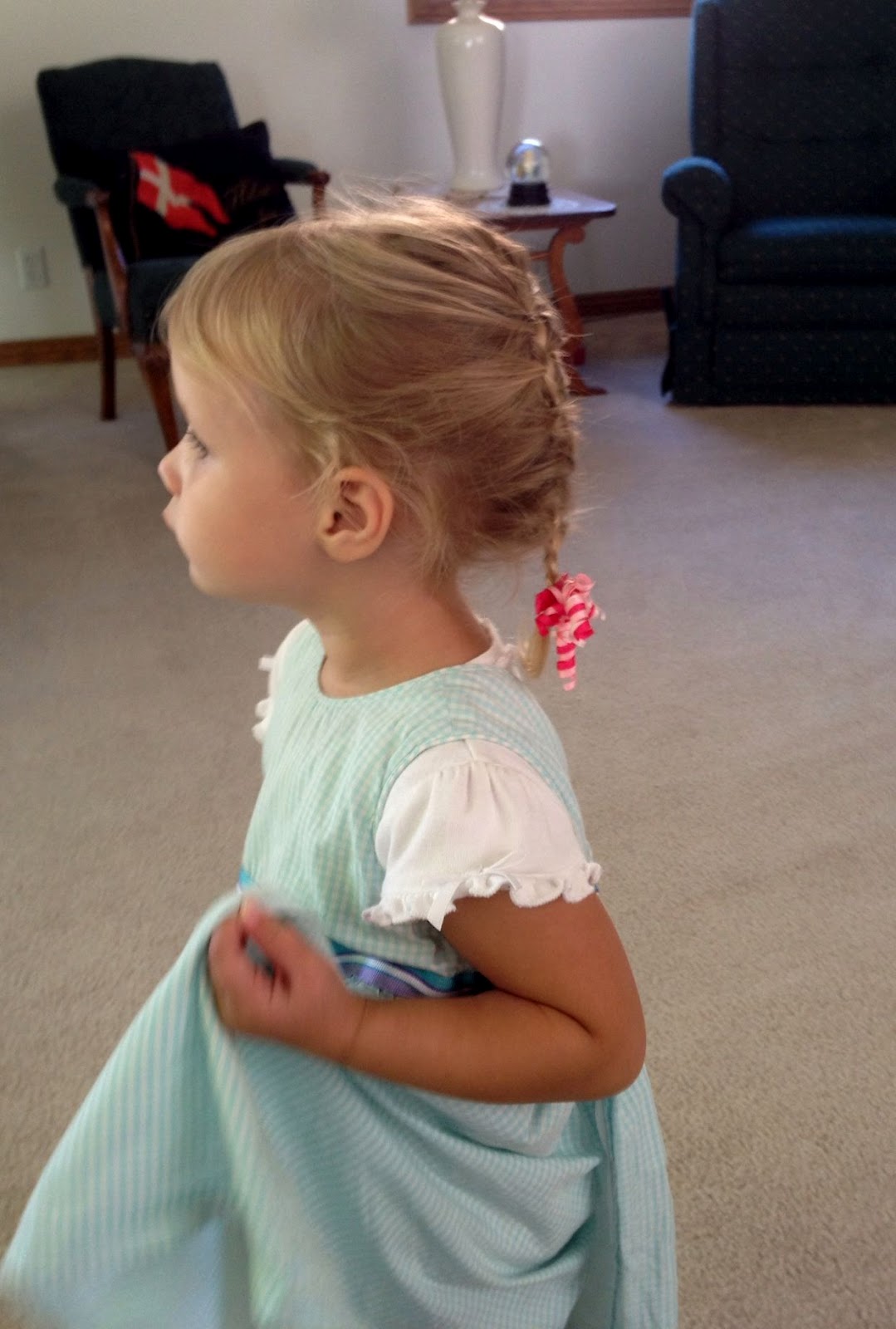
Daisy was very proud of her (teeny-tiny) French braid!

Pioneer Johnnycake, interviews, and homemade butter

Here's our basic schedule for  the Pioneer Unit. I'm sure I won't always want to/be able to make up weekly schedules like this, but it's a method that's working well for me right now. And even if I don't always stick to it religiously, it helps me to have an overview to work from (and usually before I post it, I update it to show what we actually did, which I'm hoping will help me with planning later).

A couple things we enjoyed that aren't pictured: 
--looking at this map of the westward trails, and comparing it with roads of today
--interviewing Grandma--who is NOT a pioneer, of course, but we talked about journals and personal histories and how it is that we know about what life was like before we were born. The three boys came up with four interview questions each to ask Grandma about her life when she was their age. Then we practiced and practiced (by role playing) HOW to interview someone. Everyone thought this was hilarious because they played the part of Grandma and I played the part of one of them doing the wrong thing. That ranged from interrupting her, to leaving the room while she was talking, to appearing uninterested ("LOOK at her while she's talking!", I kept saying) to letting her answer with just a yes or a no ("Always ask a follow-up and get more information!"). When they did the interviews for real, I thought it was so adorable to hear the following exchange:
Seb: Grandma, did you have any pets when you were young?
Grandma: Yes, a parakeet.
Seb: Oh, and so . . . hmm, a parakeet. Tell me more! Just, tell me everything about it. And about any other pets, if you had any. IF you had any, but it's fine if you didn't. A parakeet is perfectly good!

On to the food elements: You can't do a unit on pioneers without making butter, right? That's one of the few things I remember from first grade---making butter in baby food jars. But after watching the Happy Scientist's video [I don't think you need a subscription for this one?], I learned more about the process than I'd ever known before. He explains it so clearly! I also appreciated his tips on how, exactly, to shake up the cream. (Slow, deliberate shakes, after having left your cream out of the fridge overnight, make the process way easier and faster! Hooray!)
Butter, nice and soft, with buttermilk in the glass behind

Yum.

On another day, we made johnnycakes (or journeycakes), which are cornmeal pancakes, because we love this book:
and because we read they were a favorite of Joseph Smith's. There are lots of recipes out there, ranging from really simple (cornmeal, water, and salt) to more complex. I assume that the pioneers would have adapted the recipe to their various situations---so, maybe the eggless version out on the trail, but using eggs and sugar, if they had them, at home. We used this recipe, which maybe wasn't the most authentically pioneer-y, but looked like it would be good. And it was. The pancakes themselves were pretty crumbly (and a bit dry---I would need to do more experimenting with the liquids to perfect it) but tasted great with our vanilla syrup.
This reminds me of the drawing of the "tiger pancakes" in the story of Little Black Sambo (or its improved update, The Story of Little Babaji) 
Related Posts Plugin for WordPress, Blogger...